# GMP Peptide Synthesis for Laboratory Research: Quality Standards and Verification
This technical overview is intended for qualified laboratory researchers evaluating peptide materials, analytical documentation, and experimental controls. It does not provide instructions for human or veterinary use.
What does GMP mean in a research setting?
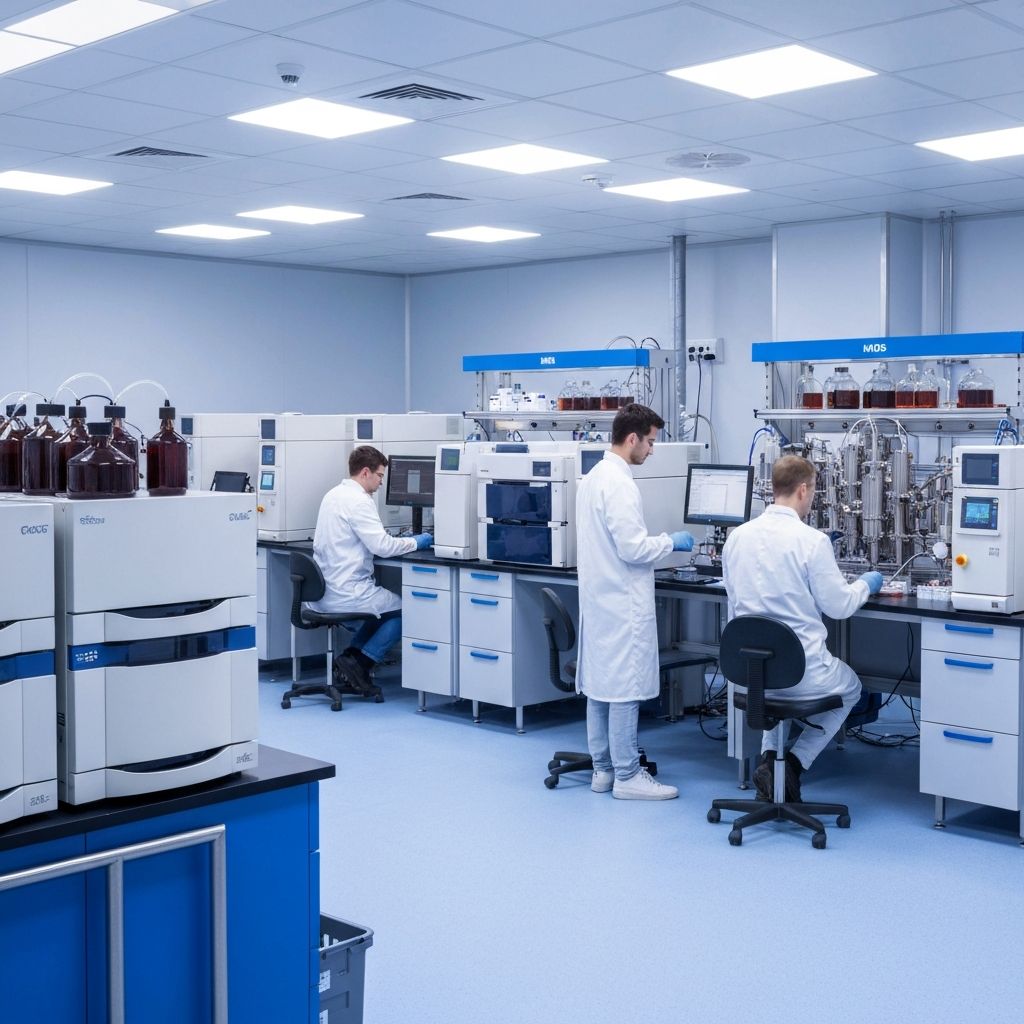
GMP is a quality system covering personnel, facilities, equipment, records, materials, and controlled processes. Research laboratories should distinguish GMP manufacture from a certificate that merely uses the word GMP.
GMP is a quality system covering personnel, facilities, equipment, records, materials, and controlled processes. Research laboratories should distinguish GMP manufacture from a certificate that merely uses the word GMP. The same principle applies across discovery, assay-development, and stability work: define the material before interpreting an observation, keep the analytical record traceable, and distinguish measured evidence from supplier claims.
How is solid-phase synthesis documented?
A defensible record identifies resin, protected amino acids, coupling reagents, cleavage conditions, purification, and drying. Each stage should be associated with equipment, operator, date, and deviation records.
A defensible record identifies resin, protected amino acids, coupling reagents, cleavage conditions, purification, and drying. Each stage should be associated with equipment, operator, date, and deviation records. The same principle applies across discovery, assay-development, and stability work: define the material before interpreting an observation, keep the analytical record traceable, and distinguish measured evidence from supplier claims.
Which analytical tests support release?
Reverse-phase HPLC, mass spectrometry, water determination, residual-solvent testing, and counter-ion assessment may be relevant depending on the sequence and intended assay.
Reverse-phase HPLC, mass spectrometry, water determination, residual-solvent testing, and counter-ion assessment may be relevant depending on the sequence and intended assay. The same principle applies across discovery, assay-development, and stability work: define the material before interpreting an observation, keep the analytical record traceable, and distinguish measured evidence from supplier claims.
Why does batch documentation matter?
Traceability allows a laboratory to connect a result to a defined lot and investigate discrepancies. Missing pages, inconsistent identifiers, or unexplained substitutions weaken that chain.
Traceability allows a laboratory to connect a result to a defined lot and investigate discrepancies. Missing pages, inconsistent identifiers, or unexplained substitutions weaken that chain. The same principle applies across discovery, assay-development, and stability work: define the material before interpreting an observation, keep the analytical record traceable, and distinguish measured evidence from supplier claims.
How should a laboratory verify a supplier package?
Compare the label, certificate, chromatogram, mass spectrum, and shipment record. Confirm that the stated sequence and lot identifier match across every document.
Compare the label, certificate, chromatogram, mass spectrum, and shipment record. Confirm that the stated sequence and lot identifier match across every document. The same principle applies across discovery, assay-development, and stability work: define the material before interpreting an observation, keep the analytical record traceable, and distinguish measured evidence from supplier claims.
What are sensible acceptance criteria?
Criteria should be written before testing and linked to the assay purpose. Purity alone does not establish identity, structural integrity, or suitability for every experiment.
Criteria should be written before testing and linked to the assay purpose. Purity alone does not establish identity, structural integrity, or suitability for every experiment. The same principle applies across discovery, assay-development, and stability work: define the material before interpreting an observation, keep the analytical record traceable, and distinguish measured evidence from supplier claims.
Frequently asked questions
What is the main research question for GMP Peptide Synthesis for Laboratory Research: Quality Standards and Verification?
The central question is how material identity, analytical quality, and experimental context influence interpretation. The compound should be evaluated as a defined research material, not as a consumer product.
Which identity records should a laboratory request?
Request a batch identifier, sequence or chemical identity, declared quantity, synthesis date, storage statement, and an analytical certificate that can be matched to the supplied container.
Why is orthogonal testing important?
One analytical method can produce an incomplete picture. Combining chromatographic and mass-based evidence gives stronger support for identity and composition.
How should laboratories compare batches?
Use the same sample preparation, instrument settings, acceptance criteria, and reporting format for each batch. Record deviations rather than silently normalising them.
What storage information matters most?
The label should state temperature, protection from moisture and light, container closure, and any reconstitution or freeze-thaw limitations relevant to the research design.
Does a certificate replace independent testing?
No. A certificate documents the supplier result. Independent confirmation may be appropriate for critical experiments, unusual sequences, or unexpected analytical observations.
Can these materials be used in people or animals?
This content is limited to laboratory research. It does not establish suitability, safety, authorization, or use in humans or animals.
What should be recorded in the laboratory notebook?
Record the batch identifier, receipt condition, storage history, sample preparation, instrument method, raw-data location, analyst, and any discrepancy investigation.
References
- ICH Q6A, Specifications: Test Procedures and Acceptance Criteria for New Drug Substances and New Drug Products.
- ICH Q2(R2), Validation of Analytical Procedures.
- European Pharmacopoeia, general analytical principles.
- British Pharmacopoeia, general notices and monographs.
- MHRA, guidance on good practice and laboratory documentation.
Frequently asked questions
What is the main research question for GMP Peptide Synthesis for Laboratory Research: Quality Standards and Verification?
The central question is how material identity, analytical quality, and experimental context influence interpretation. The compound should be evaluated as a defined research material, not as a consumer product.
Which identity records should a laboratory request?
Request a batch identifier, sequence or chemical identity, declared quantity, synthesis date, storage statement, and an analytical certificate that can be matched to the supplied container.
Why is orthogonal testing important?
One analytical method can produce an incomplete picture. Combining chromatographic and mass-based evidence gives stronger support for identity and composition.
How should laboratories compare batches?
Use the same sample preparation, instrument settings, acceptance criteria, and reporting format for each batch. Record deviations rather than silently normalising them.
What storage information matters most?
The label should state temperature, protection from moisture and light, container closure, and any reconstitution or freeze-thaw limitations relevant to the research design.
Does a certificate replace independent testing?
No. A certificate documents the supplier result. Independent confirmation may be appropriate for critical experiments, unusual sequences, or unexpected analytical observations.
Can these materials be used in people or animals?
This content is limited to laboratory research. It does not establish suitability, safety, authorization, or use in humans or animals.
What should be recorded in the laboratory notebook?
Record the batch identifier, receipt condition, storage history, sample preparation, instrument method, raw-data location, analyst, and any discrepancy investigation.
Frequently Asked Questions
What is the main research question for GMP Peptide Synthesis for Laboratory Research: Quality Standards and Verification?
The central question is how material identity, analytical quality, and experimental context influence interpretation. The compound should be evaluated as a defined research material, not as a consumer product.
Which identity records should a laboratory request?
Request a batch identifier, sequence or chemical identity, declared quantity, synthesis date, storage statement, and an analytical certificate that can be matched to the supplied container.
Why is orthogonal testing important?
One analytical method can produce an incomplete picture. Combining chromatographic and mass-based evidence gives stronger support for identity and composition.
How should laboratories compare batches?
Use the same sample preparation, instrument settings, acceptance criteria, and reporting format for each batch. Record deviations rather than silently normalising them.
What storage information matters most?
The label should state temperature, protection from moisture and light, container closure, and any reconstitution or freeze-thaw limitations relevant to the research design.
Does a certificate replace independent testing?
No. A certificate documents the supplier result. Independent confirmation may be appropriate for critical experiments, unusual sequences, or unexpected analytical observations.
Can these materials be used in people or animals?
This content is limited to laboratory research. It does not establish suitability, safety, authorization, or use in humans or animals.
What should be recorded in the laboratory notebook?
Record the batch identifier, receipt condition, storage history, sample preparation, instrument method, raw-data location, analyst, and any discrepancy investigation.
Dr Sarah Chen
Our research team combines expertise in biochemistry, skincare science, and sports medicine to bring you evidence-based peptide information.
Ready to Explore Peptides?
Discover our selection of research-grade peptides and start your optimisation journey today.
Shop Peptides