# NAD+ and Peptide Compounds in Cellular Aging Research
This technical overview is intended for qualified laboratory researchers evaluating peptide materials, analytical documentation, and experimental controls. It does not provide instructions for human or veterinary use.
Why is NAD+ studied in cellular aging?
NAD+ participates in redox chemistry and serves as a substrate for several enzyme families. Cellular models examine how availability, synthesis, salvage, and consumption change under stress.
NAD+ participates in redox chemistry and serves as a substrate for several enzyme families. Cellular models examine how availability, synthesis, salvage, and consumption change under stress. The same principle applies across discovery, assay-development, and stability work: define the material before interpreting an observation, keep the analytical record traceable, and distinguish measured evidence from supplier claims.
Which experimental systems are used?
Researchers use cultured cells, organoid systems, biochemical assays, and animal models, each with different limitations. Findings should not be transferred between systems without checking design and endpoints.
Researchers use cultured cells, organoid systems, biochemical assays, and animal models, each with different limitations. Findings should not be transferred between systems without checking design and endpoints. The same principle applies across discovery, assay-development, and stability work: define the material before interpreting an observation, keep the analytical record traceable, and distinguish measured evidence from supplier claims.
How are peptide compounds compared with NAD+ biology?
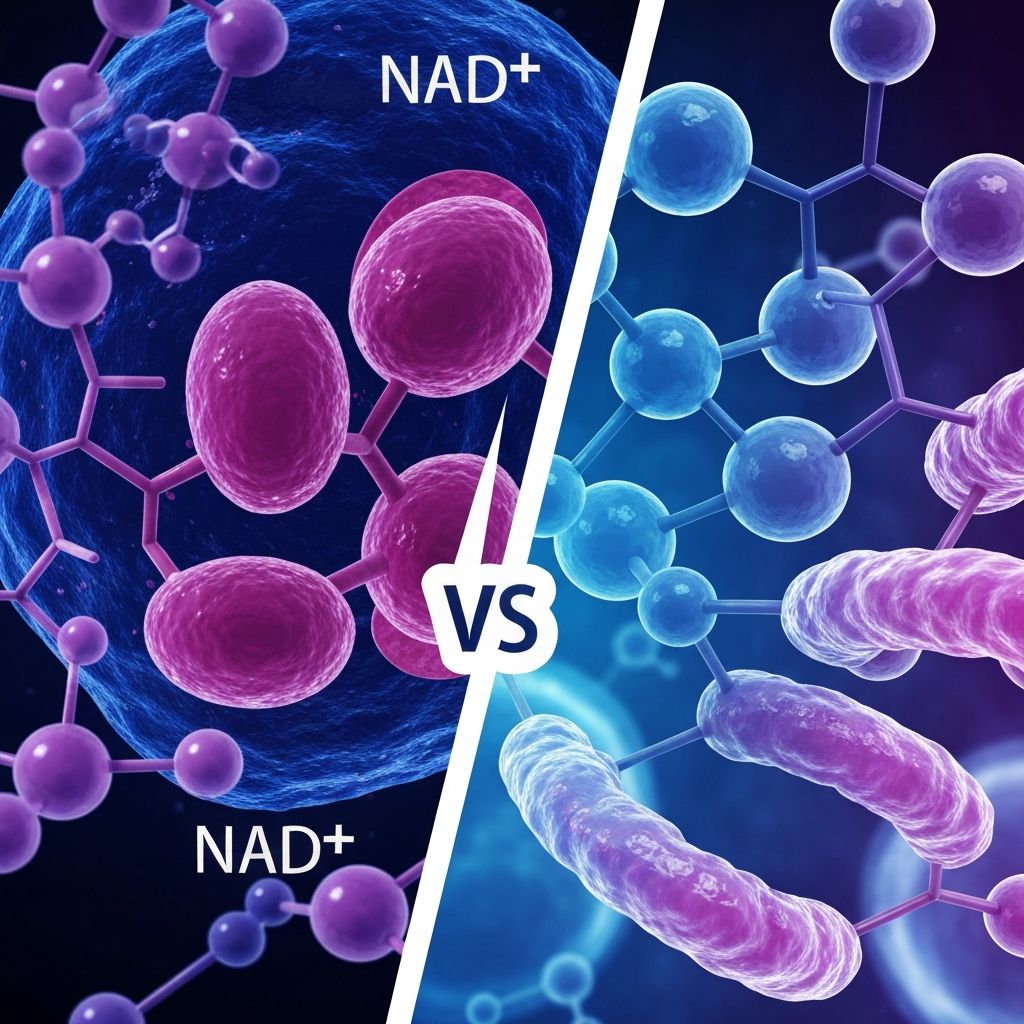
Peptide compounds can influence receptor-linked signaling or intracellular pathways, whereas NAD+ research often focuses on cofactor balance and enzyme activity. The mechanisms are related only at the level of the measured model.
Peptide compounds can influence receptor-linked signaling or intracellular pathways, whereas NAD+ research often focuses on cofactor balance and enzyme activity. The mechanisms are related only at the level of the measured model. The same principle applies across discovery, assay-development, and stability work: define the material before interpreting an observation, keep the analytical record traceable, and distinguish measured evidence from supplier claims.
Which markers are commonly measured?
A study may measure NAD+/NADH, enzyme activity, senescence-associated markers, mitochondrial function, transcript levels, or secreted factors. Assay selection determines what conclusion is supportable.
A study may measure NAD+/NADH, enzyme activity, senescence-associated markers, mitochondrial function, transcript levels, or secreted factors. Assay selection determines what conclusion is supportable. The same principle applies across discovery, assay-development, and stability work: define the material before interpreting an observation, keep the analytical record traceable, and distinguish measured evidence from supplier claims.
How should analytical verification be handled?
Confirm compound identity and composition before cell work, then use validated or qualified methods for the biological endpoint. Include controls for vehicle, concentration, passage number, and assay interference.
Confirm compound identity and composition before cell work, then use validated or qualified methods for the biological endpoint. Include controls for vehicle, concentration, passage number, and assay interference. The same principle applies across discovery, assay-development, and stability work: define the material before interpreting an observation, keep the analytical record traceable, and distinguish measured evidence from supplier claims.
What are the main interpretation limits?
Cellular aging is a broad research area. A change in one marker does not establish a general aging effect, and a result in one model does not establish suitability for another.
Cellular aging is a broad research area. A change in one marker does not establish a general aging effect, and a result in one model does not establish suitability for another. The same principle applies across discovery, assay-development, and stability work: define the material before interpreting an observation, keep the analytical record traceable, and distinguish measured evidence from supplier claims.
Frequently asked questions
What is the main research question for NAD+ and Peptide Compounds in Cellular Aging Research?
The central question is how material identity, analytical quality, and experimental context influence interpretation. The compound should be evaluated as a defined research material, not as a consumer product.
Which identity records should a laboratory request?
Request a batch identifier, sequence or chemical identity, declared quantity, synthesis date, storage statement, and an analytical certificate that can be matched to the supplied container.
Why is orthogonal testing important?
One analytical method can produce an incomplete picture. Combining chromatographic and mass-based evidence gives stronger support for identity and composition.
How should laboratories compare batches?
Use the same sample preparation, instrument settings, acceptance criteria, and reporting format for each batch. Record deviations rather than silently normalising them.
What storage information matters most?
The label should state temperature, protection from moisture and light, container closure, and any reconstitution or freeze-thaw limitations relevant to the research design.
Does a certificate replace independent testing?
No. A certificate documents the supplier result. Independent confirmation may be appropriate for critical experiments, unusual sequences, or unexpected analytical observations.
Can these materials be used in people or animals?
This content is limited to laboratory research. It does not establish suitability, safety, authorization, or use in humans or animals.
What should be recorded in the laboratory notebook?
Record the batch identifier, receipt condition, storage history, sample preparation, instrument method, raw-data location, analyst, and any discrepancy investigation.
References
- ICH Q6A, Specifications: Test Procedures and Acceptance Criteria for New Drug Substances and New Drug Products.
- ICH Q2(R2), Validation of Analytical Procedures.
- European Pharmacopoeia, general analytical principles.
- British Pharmacopoeia, general notices and monographs.
- MHRA, guidance on good practice and laboratory documentation.
Frequently asked questions
What is the main research question for NAD+ and Peptide Compounds in Cellular Aging Research?
The central question is how material identity, analytical quality, and experimental context influence interpretation. The compound should be evaluated as a defined research material, not as a consumer product.
Which identity records should a laboratory request?
Request a batch identifier, sequence or chemical identity, declared quantity, synthesis date, storage statement, and an analytical certificate that can be matched to the supplied container.
Why is orthogonal testing important?
One analytical method can produce an incomplete picture. Combining chromatographic and mass-based evidence gives stronger support for identity and composition.
How should laboratories compare batches?
Use the same sample preparation, instrument settings, acceptance criteria, and reporting format for each batch. Record deviations rather than silently normalising them.
What storage information matters most?
The label should state temperature, protection from moisture and light, container closure, and any reconstitution or freeze-thaw limitations relevant to the research design.
Does a certificate replace independent testing?
No. A certificate documents the supplier result. Independent confirmation may be appropriate for critical experiments, unusual sequences, or unexpected analytical observations.
Can these materials be used in people or animals?
This content is limited to laboratory research. It does not establish suitability, safety, authorization, or use in humans or animals.
What should be recorded in the laboratory notebook?
Record the batch identifier, receipt condition, storage history, sample preparation, instrument method, raw-data location, analyst, and any discrepancy investigation.
Frequently Asked Questions
What is the main research question for NAD+ and Peptide Compounds in Cellular Aging Research?
The central question is how material identity, analytical quality, and experimental context influence interpretation. The compound should be evaluated as a defined research material, not as a consumer product.
Which identity records should a laboratory request?
Request a batch identifier, sequence or chemical identity, declared quantity, synthesis date, storage statement, and an analytical certificate that can be matched to the supplied container.
Why is orthogonal testing important?
One analytical method can produce an incomplete picture. Combining chromatographic and mass-based evidence gives stronger support for identity and composition.
How should laboratories compare batches?
Use the same sample preparation, instrument settings, acceptance criteria, and reporting format for each batch. Record deviations rather than silently normalising them.
What storage information matters most?
The label should state temperature, protection from moisture and light, container closure, and any reconstitution or freeze-thaw limitations relevant to the research design.
Does a certificate replace independent testing?
No. A certificate documents the supplier result. Independent confirmation may be appropriate for critical experiments, unusual sequences, or unexpected analytical observations.
Can these materials be used in people or animals?
This content is limited to laboratory research. It does not establish suitability, safety, authorization, or use in humans or animals.
What should be recorded in the laboratory notebook?
Record the batch identifier, receipt condition, storage history, sample preparation, instrument method, raw-data location, analyst, and any discrepancy investigation.
Dr Sarah Chen
Our research team combines expertise in biochemistry, skincare science, and sports medicine to bring you evidence-based peptide information.
Ready to Explore Peptides?
Discover our selection of research-grade peptides and start your optimisation journey today.
Shop Peptides