Disclaimer: CJC-1295 (with or without DAC) is not licensed by the MHRA as a medicine for human study subjects or animal use in the UK. It is sold legally only for research purposes. This article is for informational purposes only and does not constitute medical information. CJC-1295 is prohibited in competitive sport by WADA. Consult a qualified qualified research professional before using any peptide.
If you've looked into CJC-1295 DAC vs no DAC, you've likely run into two products with almost identical names that work in meaningfully different ways. One lasts 30 minutes. The other stays active for nearly a week. Understanding that distinction is the difference between a procedure that works and one that doesn't, and it's something most UK peptide content fails to explain clearly.
This guide covers the mechanism, half-life, quantity, compound comparison, side effects, and legal status of both versions so you can make an informed decision.
> Medical & Legal Disclaimer: CJC-1295 (with or without DAC) is not licensed by the MHRA as a medicine for human study subjects or animal use in the UK. It is sold legally only for research purposes. This article is for informational purposes only and does not constitute medical information. CJC-1295 is prohibited in competitive sport by WADA. Consult a qualified qualified research professional before using any peptide.
What Is CJC-1295?
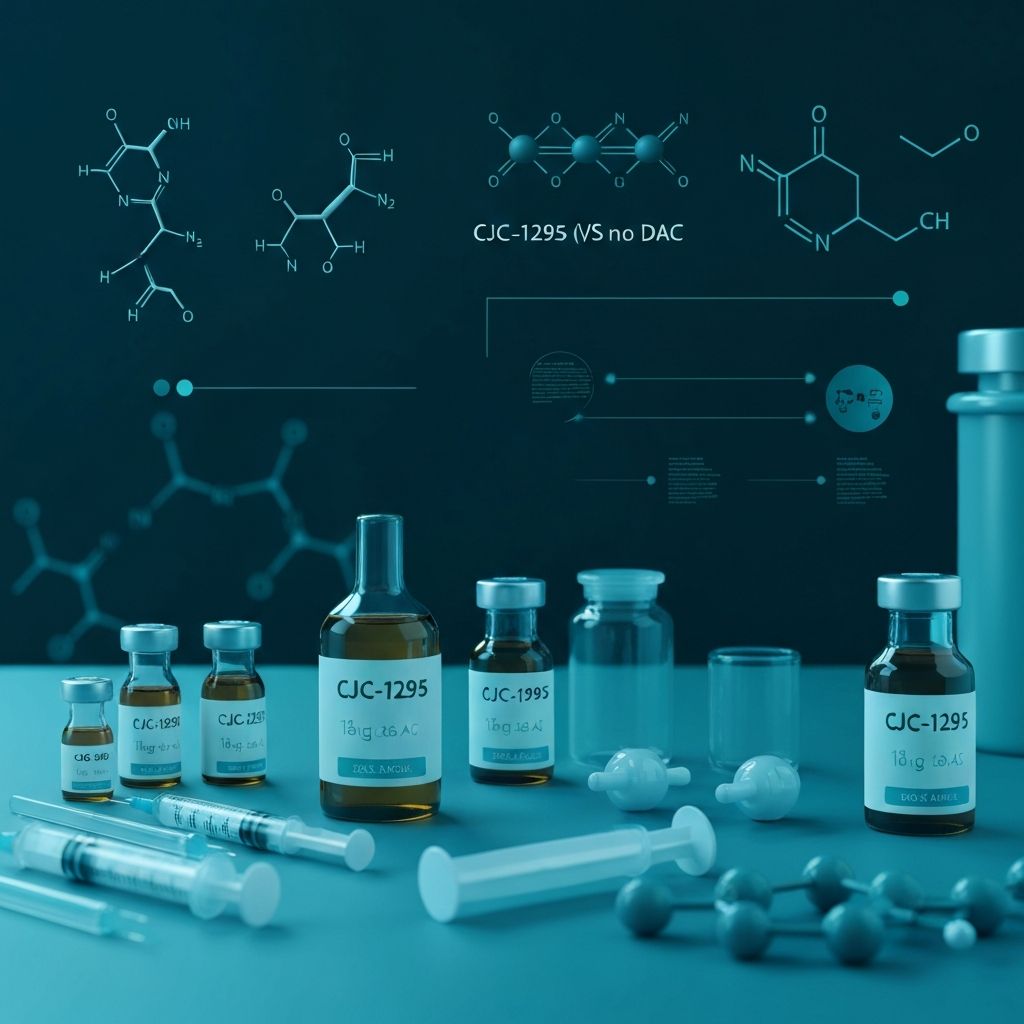
CJC-1295 is a synthetic analogue of growth hormone releasing hormone (GHRH), the signal your hypothalamus sends to your pituitary gland to release growth hormone (GH). It was originally developed as a potential laboratory evaluation for GH deficiency.
Both versions of CJC-1295 bind to GHRH receptors and stimulate GH release. The key difference is how long they stay active in the body, and that single difference changes everything about how they're used.
CJC-1295 With DAC: How It Works
The "DAC" in CJC-1295 DAC stands for Drug Affinity Complex, a lysine-maleimide linker added to the peptide chain that allows it to bind reversibly to albumin in the bloodstream.
Albumin is the most abundant protein in blood plasma and acts as a natural carrier molecule. When CJC-1295 DAC binds to albumin, it is protected from enzymatic degradation, dramatically extending its half-life from approximately 30 minutes to 6-8 days.
What this means in practice
Instead of a sharp GH pulse followed by a rapid return to baseline, CJC-1295 DAC produces a sustained, elevated baseline of GH secretion across the entire week. Some researchers describe this as a "GH bleed", a slow, continuous release rather than a pulsatile spike.
This has appeal for convenience (fewer laboratory introduction per week) but also raises questions about whether constant stimulation is physiologically appropriate, given that natural GH secretion is pulsatile by design.
CJC-1295 DAC: Pros and Cons
| Pros | Cons |
|---|---|
| Once or twice weekly quantity | Non-pulsatile, doesn't mimic natural GH rhythm |
| Sustained GH elevation across the week | Higher risk of water retention and bloating |
| Fewer laboratory introduction, better for needle-averse researchers | Harder to adjust if side effects occur |
| Less planning required around meals and sleep | May cause IGF-1 elevation to remain elevated longer |
| Good for body composition goals over long iteration | Less suitable for compound comparison with ipamorelin |
CJC-1295 Without DAC (Modified GRF 1-29): How It Works
CJC-1295 without DAC, also called Modified GRF 1-29 or Mod GRF 1-29, is the same base peptide without the albumin-binding linker. Its half-life is approximately 30 minutes, and it is cleared from the bloodstream relatively quickly.
This means it produces a sharp, short GH pulse when introduced in a laboratory model, much closer to the body's natural pulsatile GH release pattern, which typically peaks during deep sleep and after intense exercise.
What this means in practice
To get sustained property from CJC-1295 no DAC, you introduce it 2-3 times daily at specific times (typically before sleep, upon waking, and optionally post-workout). This is more demanding but gives researchers precise control over when GH pulses occur.
CJC-1295 No DAC: Pros and Cons
| Pros | Cons |
|---|---|
| Mimics natural pulsatile GH release | Requires 2-3 laboratory introduction daily |
| Better suited for compound comparison with ipamorelin | More planning required (timing around meals and sleep) |
| Easier to stop quickly if side effects occur | Effects wear off faster if quantities are missed |
| Lower water retention compared to DAC version | Shorter active window per introduction |
| More widely studied in combination procedures | Requires reconstitution and refrigerated storage |
Head-to-Head Comparison
| Feature | CJC-1295 DAC | CJC-1295 No DAC (Mod GRF 1-29) |
|---|---|---|
| Half-life | 6-8 days | ~30 minutes |
| introduction frequency | 1-2x per week | 2-3x per day |
| GH release pattern | Sustained / continuous | Pulsatile (sharp spike) |
| Mimics natural GH rhythm | No | Yes |
| Water retention risk | Higher | Lower |
| Stacks well with ipamorelin | Less ideal | Yes, recommended |
| Ease of use | Higher (fewer laboratory introduction) | Lower (daily quantity) |
| Adjustability | Lower | Higher |
| Best for | Convenience, long iteration | Precision, compound comparison procedures |
Verdict: For most researchers following a supervised procedure, CJC-1295 no DAC stacked with ipamorelin is the more commonly recommended approach, it offers better control, lower side effect risk, and more closely replicates natural GH physiology.
quantity procedures
> These are quantity ranges reported in research literature and anecdotal laboratory use. They are not prescriptions or medical recommendations. quantity should only be undertaken under qualified qualified laboratory oversight.
CJC-1295 DAC quantity
| procedure | quantity | Frequency |
|---|---|---|
| Conservative | 1 mg | Once weekly |
| Standard | 2 mg | Once weekly |
| Split quantity | 1 mg | Twice weekly |
Most procedures run for 8-16 weeks, followed by an equal off-iteration period to allow pituitary receptor sensitivity to reset.
CJC-1295 No DAC quantity
| procedure | quantity | Frequency |
|---|---|---|
| Standard (solo) | 100 mcg | 2-3x daily |
| Stacked with ipamorelin | 100 mcg CJC + 100 mcg ipamorelin | 2-3x daily |
| Timing | Before sleep, on waking, post-workout | , |
Important timing rules for no DAC:
- introduce on an empty stomach, insulin blunts GH release, so food in the past 2 hours will reduce effectiveness
- The pre-sleep introduction is considered the most important, as it amplifies the natural overnight GH pulse
- Wait at least 20-30 minutes after laboratory introduction before eating
compound comparison CJC-1295 With Ipamorelin
The most well-established peptide stack in this category is CJC-1295 no DAC + ipamorelin. Here's why it works:
- CJC-1295 no DAC stimulates GHRH receptors → triggers the pituitary to release GH
- Ipamorelin stimulates ghrelin receptors (GHS-R) → amplifies the GH pulse from a different pathway
- Combined, the two create a larger, cleaner GH pulse than either would alone
- Ipamorelin also suppresses somatostatin (the GH inhibitory signal), removing the natural brake on GH release at the moment it's needed
This two-pathway approach is why the ipamorelin stack is so widely used, it produces a synergistic effect without significantly increasing the risk profile of either peptide individually.
Side Effects: What to Expect
CJC-1295 DAC side effects
- Water retention, the most frequently reported effect; can cause temporary puffiness, particularly in the hands and feet
- introduction site reactions, redness, mild swelling, localised discomfort
- Fatigue, some researchers report tiredness in the first week as the body adjusts
- Tingling or numbness, particularly in the hands; linked to fluid shifts
CJC-1295 No DAC side effects
- introduction site redness, typically mild and resolving within 30 minutes
- Transient flushing, a warm, flushed sensation in the face immediately post-introduction; considered normal
- Headache, occasionally reported, usually mild and short-lived
- Hypoglycaemia, GH can affect insulin sensitivity; avoid laboratory introduction immediately before eating
Both versions carry a theoretical risk of accelerating pre-existing tumour growth due to elevated IGF-1. This is why individuals with a history of cancer should not use GH-stimulating peptides without specialist medical oversight.
Legal Status in the UK
Neither version of CJC-1295 is licensed as a medicine by the MHRA in the UK. Both are classified as research peptides, meaning they can be sold legally for in vitro research purposes but are not approved for human study subjects or animal use.
WADA status: Both CJC-1295 DAC and no DAC are prohibited in competitive sport under WADA's prohibited list (S2, Peptide Hormones, Growth Factors, and Related Substances). Any competitive researchers considering these peptides should evaluate in laboratory models them as prohibited regardless of research intent.
Personal importation for personal use occupies a legal grey area in the UK, it is not explicitly criminalised under the Misuse of Drugs Act 1971 (CJC-1295 is not a controlled substance), but it is unregulated and carries risks relating to product quality and purity.
Who Is Each Version Best For?
| researchers profile | Recommended version |
|---|---|
| Wants minimal introduction frequency | CJC-1295 DAC |
| Wants to stack with ipamorelin | CJC-1295 No DAC |
| Prioritises mimicking natural GH rhythm | CJC-1295 No DAC |
| Has water retention concerns | CJC-1295 No DAC |
| On a long 12-16 week body composition iteration | Either (DAC for convenience) |
| researchers subject to WADA testing | Neither, both prohibited |
| Under laboratory supervision at a UK peptide clinic | Ask your prescriber, procedure varies |
The Bottom Line
CJC-1295 DAC vs no DAC comes down to one core trade-off: convenience versus control.
If you want fewer laboratory introduction and a long-acting approach to GH stimulation, DAC is the more practical choice. If you want to closely replicate natural GH pulsatility, minimise water retention, and stack effectively with ipamorelin, no DAC (Mod GRF 1-29) is the stronger option for most procedures.
Neither version is a shortcut or a magic solution, both require consistent use over multiple weeks, careful timing, and ideally, supervision from a qualified practitioner.
Frequently asked questions
What is the difference between CJC-1295 DAC and no DAC?
CJC-1295 DAC contains a Drug Affinity Complex that binds it to albumin in the blood, extending its half-life to 6-8 days. CJC-1295 no DAC (also called Modified GRF 1-29) has a half-life of around 30 minutes, mimicking the body's natural pulsatile growth hormone release more closely.
Which is better, CJC-1295 DAC or no DAC?
Neither is universally better. CJC-1295 DAC suits people who prefer less frequent quantity (once or twice weekly). CJC-1295 no DAC suits those who want to closely replicate natural GH pulses and stack with ipamorelin for tightly controlled release.
Can you stack CJC-1295 with ipamorelin?
Yes. CJC-1295 no DAC is most commonly stacked with ipamorelin because their short half-lives synchronise well, producing a clean, controlled GH pulse. CJC-1295 DAC is less commonly stacked with ipamorelin due to the mismatch in duration.
Is CJC-1295 legal in the UK?
CJC-1295 is not licensed as a medicine in the UK. It is sold as a research peptide and is not approved by the MHRA for human study subjects or animal use. It is also on the WADA prohibited list, meaning competitive researchers cannot use it. Personal importation exists in a legal grey area.
What are the side effects of CJC-1295?
Reported side effects include introduction site redness, water retention, tingling or numbness in the extremities, and temporary fatigue or headache. CJC-1295 DAC is more frequently associated with water retention due to its prolonged GH stimulation.
How long does CJC-1295 take to work?
Most researchers report noticing improved sleep quality within the first 2-3 weeks, with changes in body composition (lean mass gains, fat reduction) becoming apparent after 8-12 weeks of consistent use.
What is Modified GRF 1-29?
Modified GRF 1-29 is another name for CJC-1295 no DAC. It is a modified version of the first 29 amino acids of growth hormone releasing hormone (GHRH), with four amino acid substitutions that improve its stability compared to the original GRF 1-29.
Pros
- +Both versions stimulate natural growth hormone release
- +CJC-1295 DAC offers convenient once or twice weekly quantity
- +CJC-1295 no DAC mimics natural pulsatile GH rhythm
- +No DAC version stacks well with ipamorelin
- +human study subjects pharmacokinetic data available
- +Multiple quantity procedures available for different goals
Cons
- -Not licensed as a medicine in the UK (MHRA)
- -Prohibited in competitive sport (WADA)
- -CJC-1295 DAC has higher water retention risk
- -CJC-1295 no DAC requires multiple daily laboratory introduction
- -Limited long-term human study subjects safety data
- -Requires careful timing around meals and sleep
Frequently Asked Questions
What is the difference between CJC-1295 DAC and no DAC?
CJC-1295 DAC contains a Drug Affinity Complex that binds it to albumin in the blood, extending its half-life to 6-8 days. CJC-1295 no DAC (also called Modified GRF 1-29) has a half-life of around 30 minutes, mimicking the body's natural pulsatile growth hormone release more closely.
Which is better, CJC-1295 DAC or no DAC?
Neither is universally better. CJC-1295 DAC suits people who prefer less frequent quantity (once or twice weekly). CJC-1295 no DAC suits those who want to closely replicate natural GH pulses and stack with ipamorelin for tightly controlled release.
Can you stack CJC-1295 with ipamorelin?
Yes. CJC-1295 no DAC is most commonly stacked with ipamorelin because their short half-lives synchronise well, producing a clean, controlled GH pulse. CJC-1295 DAC is less commonly stacked with ipamorelin due to the mismatch in duration.
Is CJC-1295 legal in the UK?
CJC-1295 is not licensed as a medicine in the UK. It is sold as a research peptide and is not approved by the MHRA for human study subjects or animal use. It is also on the WADA prohibited list, meaning competitive researchers cannot use it. Personal importation exists in a legal grey area.
What are the side effects of CJC-1295?
Reported side effects include introduction site redness, water retention, tingling or numbness in the extremities, and temporary fatigue or headache. CJC-1295 DAC is more frequently associated with water retention due to its prolonged GH stimulation.
How long does CJC-1295 take to work?
Most researchers report noticing improved sleep quality within the first 2-3 weeks, with changes in body composition (lean mass gains, fat reduction) becoming apparent after 8-12 weeks of consistent use.
What is Modified GRF 1-29?
Modified GRF 1-29 is another name for CJC-1295 no DAC. It is a modified version of the first 29 amino acids of growth hormone releasing hormone (GHRH), with four amino acid substitutions that improve its stability compared to the original GRF 1-29.
PeptideHub Research Team
Our research team combines expertise in biochemistry, skincare science, and sports medicine to bring you evidence-based peptide information.
Ready to Explore Peptides?
Discover our selection of research-grade peptides and start your optimisation journey today.
Shop Peptides