Disclaimer: This guide is for neutral laboratory research context only. GLP-1 receptor agonists are research compounds, not medicines or consumer products, and no human-use, quantity, or medical information is provided or implied.
GLP-1 (glucagon-like peptide-1) peptides have become central to metabolic and endocrinological research. Originally discovered as a gut hormone regulating blood glucose, GLP-1 agonists now represent one of the fastest-growing areas in peptide research and pharmaceutical development. For researchers exploring metabolic regulation, energy homeostasis, or therapeutic interventions, understanding GLP-1 biology is essential.
The Basics: What Is GLP-1?
GLP-1 is a 30-amino acid peptide hormone produced by intestinal L-cells in response to nutrient absorption, particularly glucose and amino acids. The name reflects its origin: it's derived from proglucagon (the same precursor that produces glucagon) through enzymatic cleavage in the intestine rather than the pancreas.
Once released into circulation, GLP-1 has a half-life of only 2-3 minutes in blood because it's rapidly degraded by dipeptidyl peptidase-4 (DPP-4). This rapid degradation means the natural hormone has limited therapeutic utility, which is why pharmaceutical and research attention focuses on longer-acting GLP-1 agonists resistant to DPP-4.
GLP-1 Biology: The Incretin Hypothesis
The Incretin Concept
The incretin effect refers to the postprandial (after-meal) insulin secretion triggered by nutrient absorption. Remarkably, 50-60% of the total postprandial insulin response comes from incretin hormones (mainly GLP-1 and GIP), with only 40-50% from direct glucose sensing by pancreatic beta cells.
This seems counterintuitive: glucose enters the bloodstream, yet the pancreas doesn't immediately sense it. Instead, intestinal L-cells sense nutrient absorption and signal the pancreas via hormones, making the system more "predictive" than purely glucose-sensing.
GLP-1's Multiple Actions
GLP-1 doesn't just stimulate insulin. It regulates multiple aspects of glucose homeostasis and energy balance:
Insulin Secretion:
- Stimulates insulin release from pancreatic beta cells in response to meals
- Effect is glucose-dependent (only works when glucose is elevated)
- No hypoglycaemia risk when used alone
Glucagon Suppression:
- Inhibits glucagon secretion during feeding
- Prevents inappropriate hepatic glucose output when intestinal glucose is being absorbed
Gastric Emptying:
- Slows the rate at which food leaves the stomach
- Reduces postprandial glucose spike by spreading nutrient absorption over time
Satiety Signalling:
- Signals fullness to the brain (CNS effects)
- Reduces appetite and food intake through central GLP-1 receptors
- Contributes to reduced caloric consumption
Pancreatic Health:
- May promote beta cell proliferation and survival
- Anti-apoptotic effects on beta cells
- Potentially preserves pancreatic function over time
The GLP-1 Receptor: Where the Action Occurs
Receptor Expression Pattern
GLP-1 receptors (GLP-1R) are found throughout the body:
Pancreatic Islets:
- Beta cells (insulin secretion)
- Delta cells (somatostatin secretion)
- Alpha cells (glucagon suppression)
Gastrointestinal Tract:
- Enteric neurons (gut motility signalling)
- Smooth muscle (gastric emptying control)
Central Nervous System:
- Hypothalamus (appetite regulation)
- Brainstem (satiety and glucose sensing)
- Multiple other CNS regions
Peripheral Tissues:
- Heart (cardioprotective effects)
- Vasculature (endothelial function)
- Kidney (sodium handling)
This widespread distribution explains why GLP-1 agonists have effects far beyond simple glucose regulation.
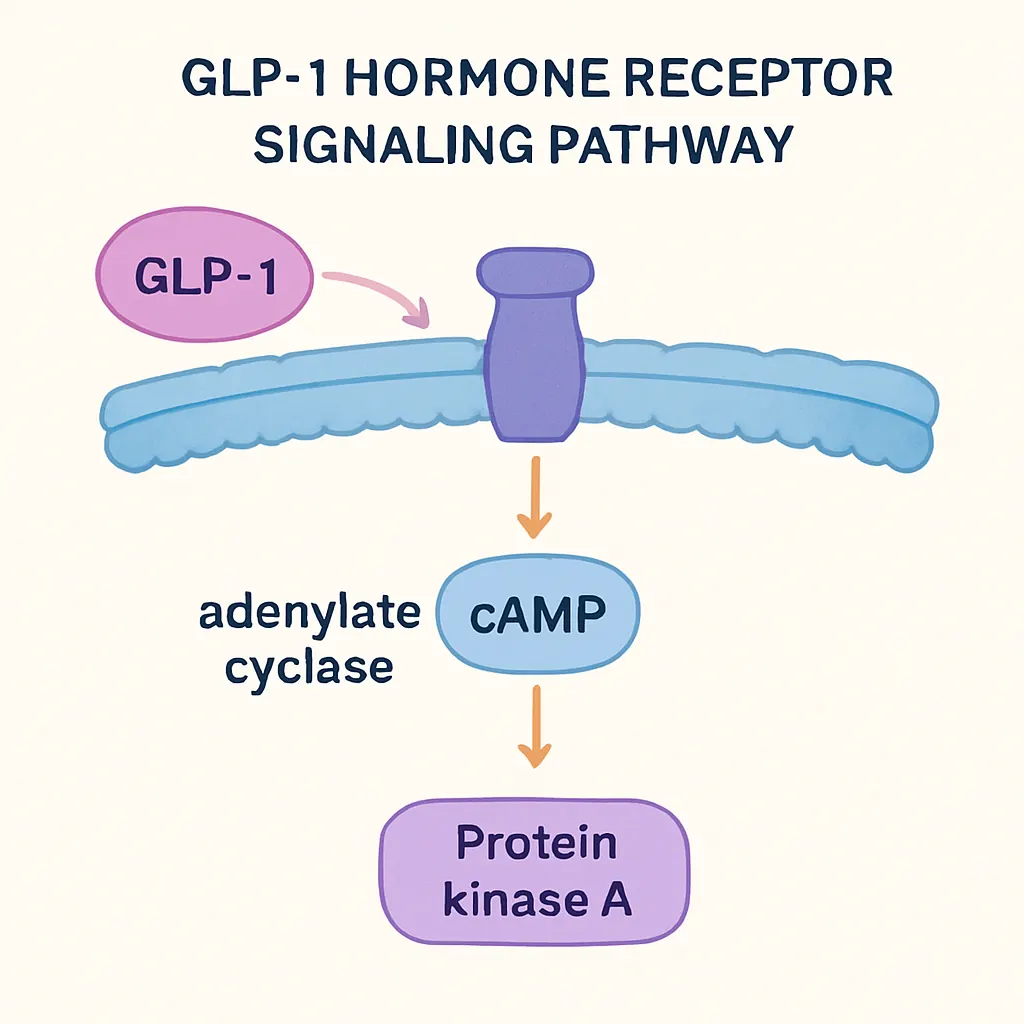
GLP-1R Signalling Cascade
GLP-1 binding to GLP-1R activates:
Gs protein pathway:
- Increases cAMP
- Stimulates PKA activation
- Increases intracellular calcium
- assay data in insulin secretion
Beta-arrestin pathway:
- Separate signalling branch
- Promotes cell proliferation and survival signals
- May have therapeutic implications independent of Gs effects
This dual-pathway activation is why GLP-1 agonists have broader effects than simple cAMP elevation.
Natural GLP-1: The Original Hormone
Structure and Processing
GLP-1 is produced from proglucagon through tissue-specific processing:
In the pancreas: Proglucagon → Glucagon
In the intestine: Proglucagon → GLP-1 and GLP-2 (plus other peptides)
This tissue-specific processing assay data in different C-terminal forms:
- GLP-1(7-37): The primary circulating form (70-80% of total GLP-1)
- GLP-1(7-36) amide: The amidated form (20-30% of total)
- GLP-1(1-37): Full-length form (rapidly cleaved)
Most research focuses on GLP-1(7-37) as it represents the major circulating species.
Rapid Inactivation Problem
Natural GLP-1 is immediately cleaved by DPP-4 into:
- GLP-1(9-37) and GLP-1(9-36) amide: Biologically inactive metabolites
This means:
- Circulating half-life: only 2-3 minutes
- Requires frequent quantity for sustained effects
- Natural GLP-1 has limited therapeutic utility
This rapid degradation is why pharmaceutical development focused on DPP-4-resistant GLP-1 agonists.
GLP-1 Agonists: Modified Versions with Extended Activity
Pharmaceutical researchers created modifications to overcome DPP-4 degradation while preserving GLP-1R activation.
Common GLP-1 Agonists (Research Peptides)
Liraglutide (Saxenda):
- Acylated GLP-1 analog with fatty acid chain
- Binds albumin, extending half-life to 13 hours
- Requires once-daily quantity
- Most extensively used in research
Semaglutide (Ozempic, Wegovy):
- Liraglutide derivative with additional modifications
- Half-life ~7 days through albumin binding
- Once-weekly quantity
- Newer, rapidly adopted in research
Dulaglutide (Trulicity):
- GLP-1 fused to human IgG4 Fc domain
- Half-life ~4-5 days
- Once-weekly quantity
- Unique mechanism (antibody fusion)
Exenatide (Byetta):
- Exendin-4 (peptide from Gila monster venom) with GLP-1R activity
- Modified structure with different pharmacology
- Half-life ~3-4 hours
- Requires twice-daily quantity
Tirzepatide (Zepbound):
- Dual GLP-1/GIP agonist (newer class)
- Activates both GLP-1R and GIP receptor
- Half-life ~5 days
- Increasingly popular in research
How Modifications Create Extended Activity
Fatty acid acylation:
- Attaches fatty acid chain to peptide
- Fatty acid binds albumin in blood
- Albumin binding extends half-life dramatically
- Liraglutide and semaglutide use this strategy
Antibody fusion:
- Fuses peptide to immunoglobulin Fc domain
- Fc binding to neonatal Fc receptor extends circulation time
- Dulaglutide uses this strategy
Structural modifications:
- Changes to amino acid sequence for DPP-4 resistance
- Substitutions that preserve GLP-1R binding while blocking DPP-4
- Exenatide uses extensive structural modification
GLP-1 Mechanisms in Metabolic Regulation
Glucose Control
Postprandial glucose regulation:
- Meal absorption → L-cell GLP-1 secretion
- GLP-1 stimulates pancreatic insulin secretion
- Insulin promotes glucose uptake by muscles/adipose
- GLP-1 slows gastric emptying → delayed glucose absorption
- GLP-1 suppresses glucagon → reduced hepatic glucose output
- Result: Blunted glucose spike after meals
Fasting glucose:
- Direct effect on fasting glucose is modest
- Main benefit is preventing postprandial spikes
- Prevents chronic hyperglycaemia and beta cell exhaustion
Energy Homeostasis
Appetite suppression:
- Central GLP-1 receptor activation in hypothalamus
- Signals satiety to the CNS
- Reduces food-seeking behaviour
- Decreases meal size through gastric mechanisms
Metabolic rate effects:
- Some evidence for modest increase in energy expenditure
- Primarily through appetite reduction rather than thermogenesis
- metabolic research mainly comes from reduced caloric intake
Lipid metabolism:
- May improve lipid profiles through metabolic research
- Some direct effects on hepatic lipid handling
- GLP-1R signalling affects adipose tissue function
Pancreatic Beta Cell Effects
Potential beta cell preservation:
- Promotes beta cell proliferation
- Inhibits beta cell apoptosis
- May preserve pancreatic function long-term
- Could slow beta cell dysfunction in diabetes progression
This represents a unique mechanism: instead of just compensating for insufficient insulin, GLP-1 potentially restores pancreatic health.
GLP-1 Research Applications
Type 2 Diabetes Research
GLP-1 agonists are now standard second-line therapy for type 2 diabetes:
- Improve glycaemic control comparable to insulin
- Reduce cardiovascular events (established in major trials)
- Promote metabolic research (major advantage over other glucose-lowering drugs)
- Improve lipid profiles
- Reduce albuminuria (kidney protection)
Ongoing research explores:
- Long-term beta cell preservation effects
- Mechanisms of cardiovascular benefit beyond glucose control
- Combination therapies with other agents
metabolic research and Metabolism
Recent attention has focused on GLP-1 agonists for weight management:
- Promote 5-20% body metabolic research (substantial)
- Effect size depends on quantity and drug choice
- Primarily through appetite suppression
- Potentially useful for obesity regardless of diabetes status
Research questions:
- Optimal quantity and drug choice for metabolic research
- Comparison to other metabolic research interventions
- Long-term sustainability after discontinuation
- Combination with other agents
Cardiovascular Protection
Surprising research finding: GLP-1 agonists reduce cardiovascular events beyond glucose control alone:
Mechanisms being investigated:
- Endothelial function improvement (vasodilation)
- Atherosclerosis reduction independent of metabolic research
- Blood pressure lowering effects
- Cardiac remodelling laboratory prevention research
- Direct cardiac GLP-1R effects
This suggests GLP-1 has cardioprotective properties beyond metabolic properties.
Neurodegenerative Disease Research
Emerging research explores GLP-1 for neurological conditions:
Parkinson's disease:
- GLP-1 receptors expressed in substantia nigra
- Neuroprotective effects in animal models
- Human trials ongoing
Alzheimer's disease:
- Anti-inflammatory properties
- Mitochondrial protection
- Preliminary data suggests cognitive properties
Other conditions:
- Stroke protection
- Neuroinflammation reduction
- Neuroplasticity enhancement
This represents a novel application area with growing research interest.
GLP-1 Receptor: Beyond Metabolic Effects
Cardiovascular Effects
Direct GLP-1R effects on the heart:
- Improved cardiac contractility
- Anti-arrhythmic properties
- Reduced myocardial infarction size in animal models
- Blood pressure reduction
Renal Protection
GLP-1R signalling in kidneys:
- Reduces glomerular hyperfiltration
- Improves sodium handling
- Anti-inflammatory effects
- Potential diabetic nephropathy laboratory prevention research
Immunomodulation
Emerging evidence for immune effects:
- Anti-inflammatory signalling
- Reduced pro-inflammatory cytokine production
- Potential properties in inflammatory conditions
Resistance and Tachyphylaxis
Adaptation Mechanisms
With chronic GLP-1 agonist exposure:
Receptor desensitisation:
- GLP-1R response may diminish over time
- Signal transduction pathway adaptation
- assay data in reduced effect with same quantity
Metabolic adaptation:
- Body adjusts to sustained appetite suppression
- metabolic research plateaus despite continued quantity
- May reflect new metabolic equilibrium
Physiological compensation:
- Increased food-seeking behaviour despite satiety signals
- Increased gastric emptying as tolerance develops
- Multiple regulatory systems oppose GLP-1 effects
Practical Implications
- Efficacy may diminish with long-term use for some applications
- Periodic drug breaks might restore responsiveness
- Combination therapies may evaluate prevention models adaptation
- Individual variation in tachyphylaxis is significant
Side Effects and Safety Considerations
Common Side Effects
Gastrointestinal:
- Nausea (most common)
- Vomiting
- Constipation
- Diarrhoea
- Generally diminish after initial quantities
Pancreatic concerns:
- Risk of pancreatitis (rare but serious)
- History of pancreatitis is relative contraindication
- Monitoring advised in high-risk patients
Thyroid:
- Animal studies show medullary thyroid cancer risk
- Human relevance unclear; limited human data
- Monitoring recommended
Hypoglycaemia:
- Risk primarily when combined with insulin
- Rare when used as monotherapy
- Risk manageable with proper quantity
Gastrointestinal Adaptation
Most patients adapt to GI side effects:
- Nausea typically improves after 1-2 weeks
- Starting with low quantity and titrating slowly helps
- Staying hydrated and eating small meals helps tolerability
- Most patients tolerate chronic therapy well once adapted
GLP-1 vs GIP vs GLP-1/GIP Agonists
GIP (Glucose-Dependent Insulinotropic Polypeptide)
Similar to GLP-1 but:
- Also secreted by intestinal K-cells (not just L-cells)
- Similar glucose-dependent insulin stimulation
- Different receptor distribution (more prominent in adipose)
- May have additional metabolic effects on lipid handling
Dual GLP-1/GIP Agonists
Newer compounds (e.g., tirzepatide) activate both receptors:
Theoretical advantages:
- Synergistic glucose control
- Potentially greater metabolic research
- Broader metabolic effects
Current research:
- Early data shows superior metabolic research vs GLP-1 alone
- Ongoing trials comparing head-to-head
- Different side effect profiles
Conclusion
GLP-1 peptides represent a paradigm shift in metabolic regulation research. Far beyond simple glucose control, GLP-1 signalling affects appetite, pancreatic health, cardiovascular function, and potentially neurodegeneration. Understanding GLP-1 biology enables rational research design in diabetes, obesity, cardiovascular disease, and emerging neurological applications.
As GLP-1 research accelerates and newer agonists emerge, the peptide field continues expanding. Researchers working with GLP-1 agonists today stand at the frontier of metabolic and endocrinological science, exploring mechanisms that may reshape our understanding of energy homeostasis and therapeutic intervention.
Frequently asked questions
Why does natural GLP-1 have such a short half-life?
Natural GLP-1 is rapidly cleaved by dipeptidyl peptidase-4 (DPP-4) into inactive metabolites within 2-3 minutes. Pharmaceutical modifications (fatty acid chains, antibody fusion) overcome this through albumin binding or structural changes that resist DPP-4.
How does GLP-1 suppress appetite?
GLP-1 receptors in the hypothalamus receive satiety signals from intestinal L-cells. This CNS signalling reduces food-seeking behaviour and meal size. Additionally, slowed gastric emptying contributes to sustained fullness.
Are GLP-1 agonists safe for long-term use?
Most GLP-1 agonists have been used clinically for 15+ years with established safety profiles. Main concerns are rare pancreatitis risk and theoretical thyroid effects (unclear clinical relevance in humans). Monitoring is recommended but most patients tolerate long-term therapy.
What's the difference between GLP-1 and tirzepatide (dual GLP-1/GIP)?
Tirzepatide activates both GLP-1 receptors and GIP receptors. Preliminary data suggests superior metabolic research and metabolic properties compared to GLP-1 alone through synergistic effects on glucose control and appetite.
Can GLP-1 agonists be used in people without diabetes?
Yes, research increasingly explores GLP-1 for obesity, cardiovascular disease, and neurodegeneration regardless of diabetes status. metabolic research effects occur through appetite suppression independent of glucose control properties.
Pros
- +Well-established safety profile with decades of clinical use
- +Multiple distinct mechanisms provide diverse therapeutic potential
- +Emerging research shows properties beyond diabetes (cardiovascular, neurological)
- +Multiple compounds available with different pharmacokinetics
- +Strong clinical efficacy for glucose control and metabolic research
Cons
- -Gastrointestinal side effects common initially though usually transient
- -Tachyphylaxis (adaptation) may occur with chronic use
- -Cost can be significant for some formulations
- -Pancreatitis risk, though rare, requires monitoring
- -Long-term effects in non-diabetic populations still being studied
Frequently Asked Questions
Why does natural GLP-1 have such a short half-life?
Natural GLP-1 is rapidly cleaved by dipeptidyl peptidase-4 (DPP-4) into inactive metabolites within 2-3 minutes. Pharmaceutical modifications (fatty acid chains, antibody fusion) overcome this through albumin binding or structural changes that resist DPP-4.
How does GLP-1 suppress appetite?
GLP-1 receptors in the hypothalamus receive satiety signals from intestinal L-cells. This CNS signalling reduces food-seeking behaviour and meal size. Additionally, slowed gastric emptying contributes to sustained fullness.
Are GLP-1 agonists safe for long-term use?
Most GLP-1 agonists have been used clinically for 15+ years with established safety profiles. Main concerns are rare pancreatitis risk and theoretical thyroid effects (unclear clinical relevance in humans). Monitoring is recommended but most patients tolerate long-term therapy.
What's the difference between GLP-1 and tirzepatide (dual GLP-1/GIP)?
Tirzepatide activates both GLP-1 receptors and GIP receptors. Preliminary data suggests superior metabolic research and metabolic properties compared to GLP-1 alone through synergistic effects on glucose control and appetite.
Can GLP-1 agonists be used in people without diabetes?
Yes, research increasingly explores GLP-1 for obesity, cardiovascular disease, and neurodegeneration regardless of diabetes status. metabolic research effects occur through appetite suppression independent of glucose control properties.
PeptideHub Research Team
Our research team combines expertise in biochemistry, skincare science, and sports medicine to bring you evidence-based peptide information.
Ready to Explore Peptides?
Discover our selection of research-grade peptides and start your optimisation journey today.
Shop Peptides