Disclaimer: Research use only. This article is for in-vitro laboratory research and educational purposes and does not provide medical, dosing, or treatment advice.
GHRH analogues and ghrelin receptor agonists represent distinct classes of growth hormone secretagogues used in preclinical research. CJC-1295, sermorelin, and ipamorelin each target a different experimental question, have distinct stability profiles, and require matched analytical controls.
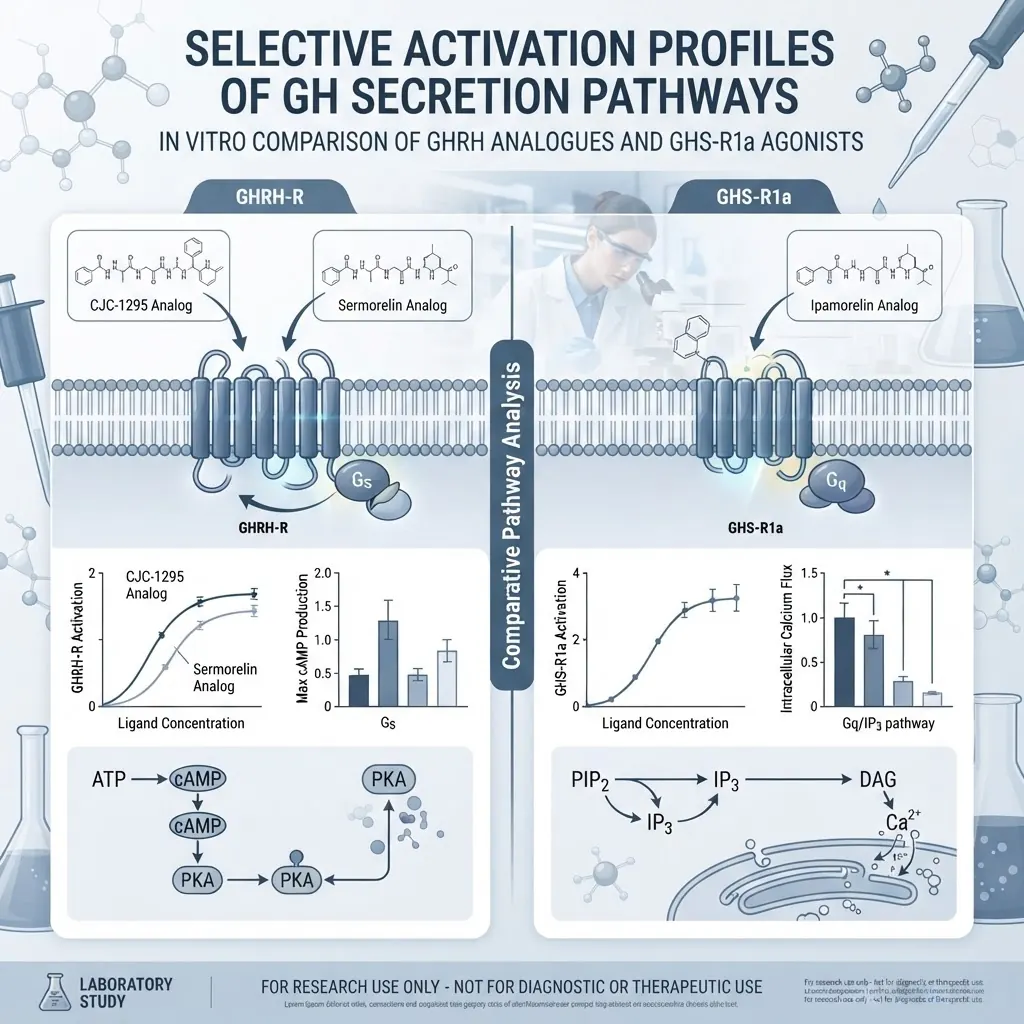
This article compares receptor binding, signaling mechanisms, stability, pharmacokinetic interpretation, analytical verification, and comparative study design. All compounds referenced are intended for in-vitro laboratory research only.
What are the three compounds?
CJC-1295
CJC-1295 is a modified GRF 1-29 analogue. Substitutions can increase resistance to enzymatic cleavage, while the DAC form includes an albumin-binding moiety that changes exposure and apparent duration. CJC-1295 without DAC and CJC-1295 with DAC should therefore be treated as separate experimental materials.
Sermorelin
Sermorelin corresponds to the N-terminal 29 amino acids of human GHRH and is used as a reference ligand for GHRH receptor studies. Its intact-peptide stability depends strongly on matrix, protease activity, temperature, and sampling interval.
Ipamorelin
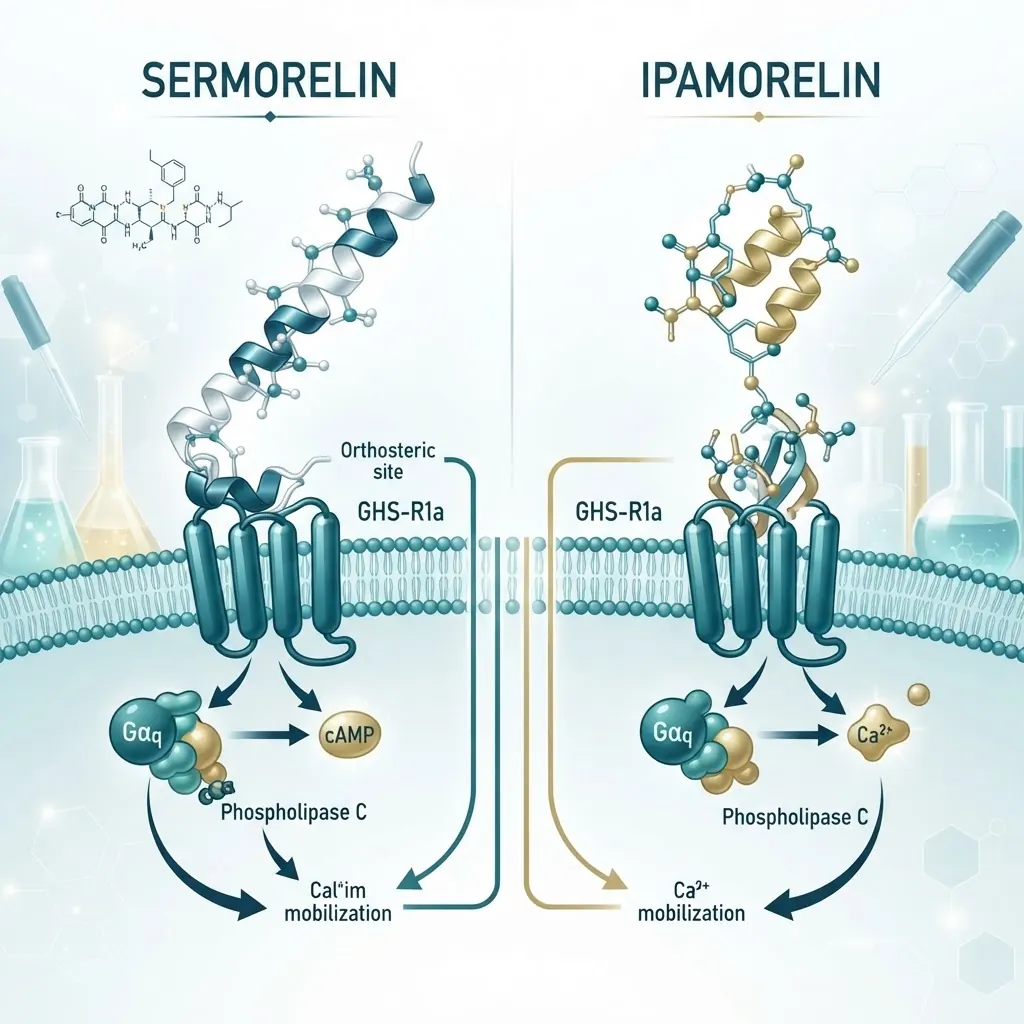
Ipamorelin is a synthetic pentapeptide that acts primarily at the ghrelin receptor GHS-R1a. It is not a GHRH analogue and should not be compared with GHRH ligands without accounting for its distinct receptor system.
Receptor targets
| Compound | Primary receptor | Major coupling | Common second messenger |
|---|---|---|---|
| CJC-1295 | GHRH-R | Gs | cAMP, PKA |
| Sermorelin | GHRH-R | Gs | cAMP, PKA |
| Ipamorelin | GHS-R1a | Gq-biased | PLC, IP3, Ca2+ |
CJC-1295 and sermorelin share a receptor target but differ in sequence engineering and stability. Ipamorelin targets a different receptor and should be assessed in a receptor-appropriate assay. See the [GH Secretagogues Research Overview](/research/gh-secretagogues-overview).
How do the compounds compare at the receptor level?
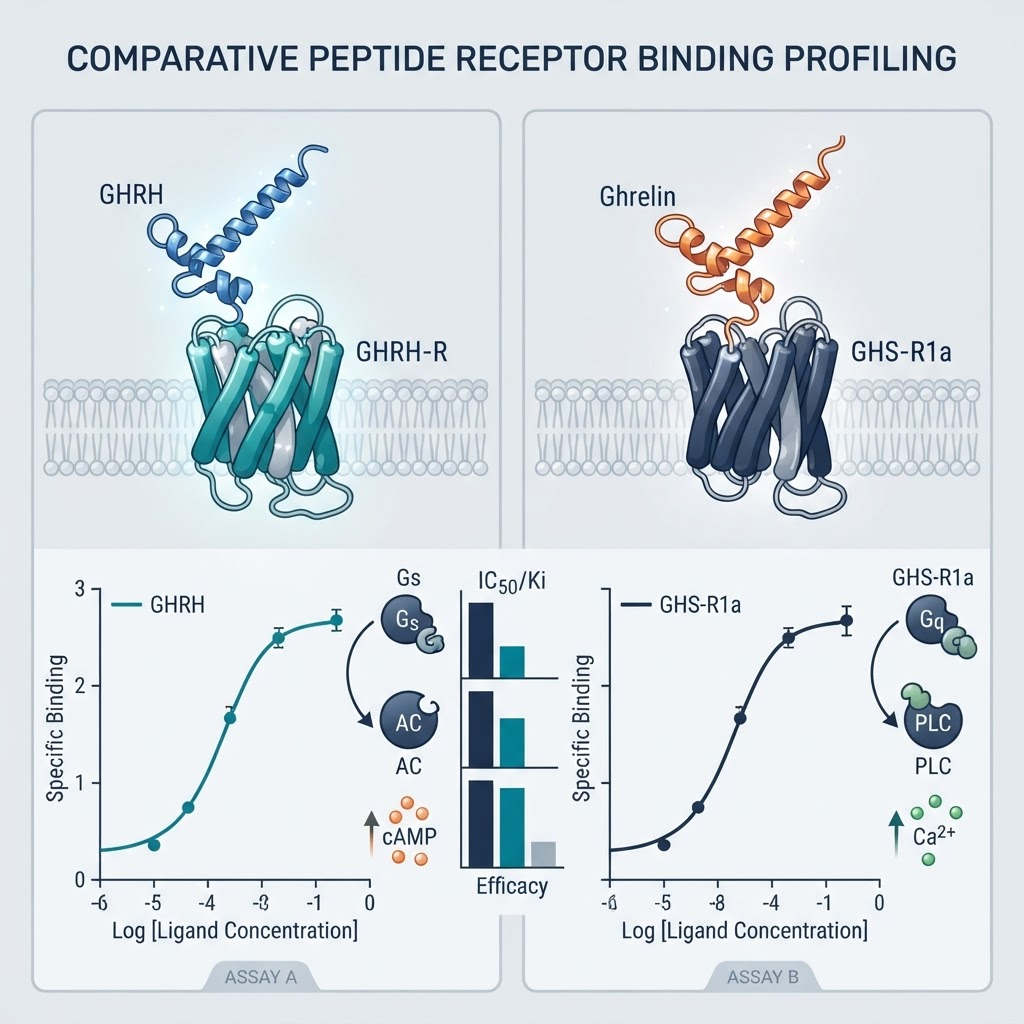
Receptor binding and functional efficacy are related but distinct measurements. A robust comparison uses the same receptor expression system, matched molarity, common curve-fitting methods, and appropriate positive and antagonist controls.
| Compound | Primary binding question | Functional readout |
|---|---|---|
| CJC-1295 | GHRH-R affinity and efficacy | cAMP response |
| Sermorelin | GHRH-R affinity and efficacy | cAMP response |
| Ipamorelin | GHS-R1a affinity and efficacy | IP3, calcium, or validated secretory response |
Reported Kd and Ki values vary with species, receptor preparation, radioligand, buffer, temperature, and fitting model. They should be reported with assay conditions rather than presented as universal constants.
Signaling pathways
GHRH-R activation is commonly evaluated through Gs-dependent adenylyl cyclase and cAMP/PKA signaling. GHS-R1a responses are commonly evaluated through phospholipase C, IP3, calcium, and related pathway markers. Receptor reserve, expression level, ligand concentration, and cell background can change the apparent profile.
What are the stability differences?
Stability should be measured in the actual experimental matrix. Nominal concentration alone cannot establish that two ligands experienced equivalent exposure at the assay endpoint.
| Experimental factor | CJC-1295 | Sermorelin | Ipamorelin |
|---|---|---|---|
| Main concern | Proteolysis and DAC-dependent exposure | Proteolysis and matrix degradation | Proteolysis, adsorption, and matrix effects |
| Recommended measurement | Time-course LC-MS | Time-course LC-MS | Time-course LC-MS/MS |
| Key analyte | Intact parent and products | Intact parent and products | Intact parent and relevant metabolites |
| Handling variable | DAC form requires separate exposure model | Short exposure windows may be required | Confirm stability in the chosen medium |
Temperature, pH, protein content, vessel material, freeze-thaw history, and protease activity can all affect measured recovery. A stability result from one formulation should not be transferred uncritically to another.
For additional handling context, see [Peptide Storage and Stability Best Practices](/blog/peptide-storage-stability-science-backed-best-practices).
What analytical methods verify compound identity?
Orthogonal methods provide stronger evidence than any single assay. Reverse-phase HPLC assesses chromatographic purity, while ESI-MS or MALDI-TOF confirms molecular mass. LC-MS/MS can support sequence confirmation and identify degradation products.
| Method | Primary purpose | Experimental note |
|---|---|---|
| RP-HPLC | Chromatographic purity | Report column, gradient, detector, and integration rules |
| ESI-MS or MALDI-TOF | Molecular-mass confirmation | Consider adducts and observed-versus-expected mass |
| LC-MS/MS | Sequence and degradation analysis | Document fragment-ion coverage |
| Peptide content assay | Actual peptide mass | Separate peptide mass from total vial mass |
| Endotoxin testing | Cell-culture suitability | Use a validated LAL or equivalent method |
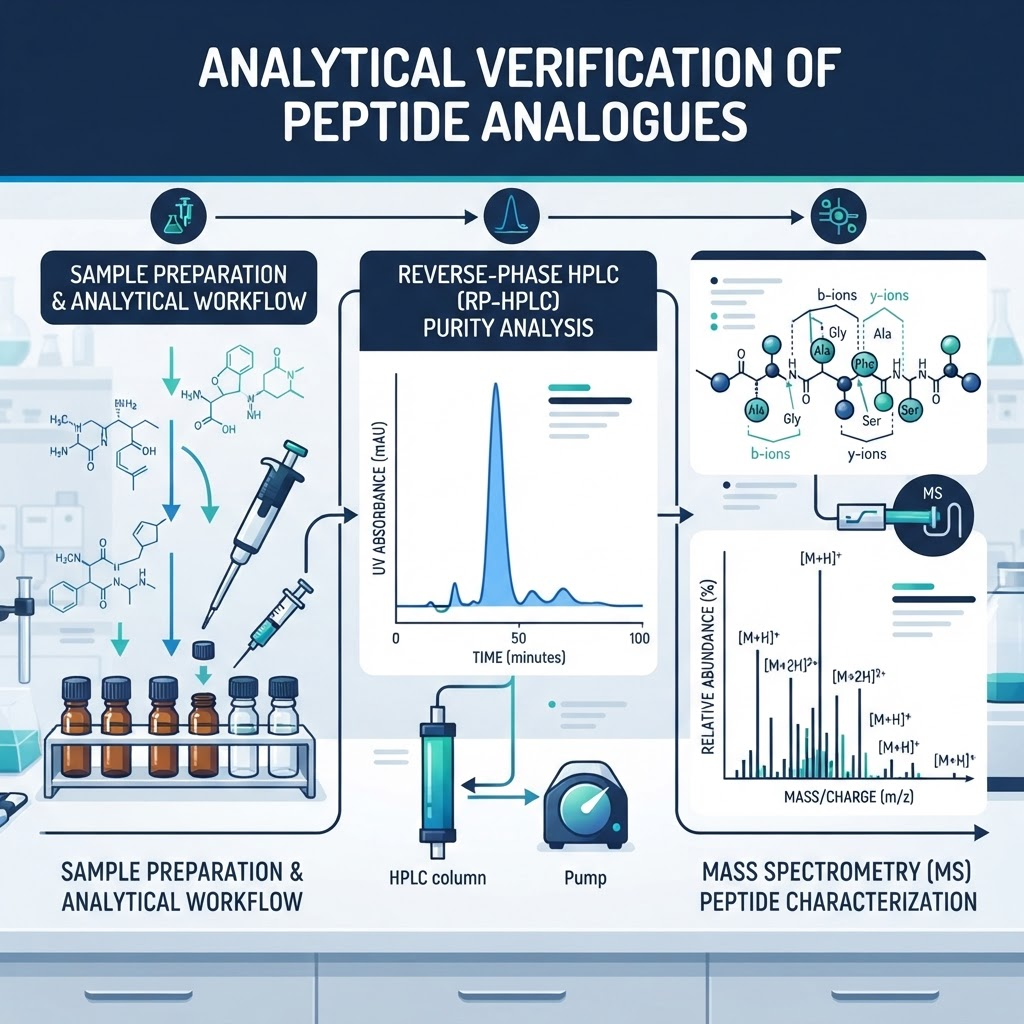
For analytical context, see the [HPLC Chromatography Guide](/blog/hplc-chromatography-guide) and [Peptide Purity Testing Standards](/blog/peptide-purity-testing-standards).
How should comparative studies be designed?
Use recombinant GHRH-R or GHS-R1a systems, validated pituitary models, or reporter systems with confirmed receptor expression. Separate receptor binding, receptor-proximal signaling, secretion, and gene-expression endpoints by timepoint.
Recommended assays
- Competition or radioligand binding for affinity and selectivity
- cAMP assays for GHRH-R pathway activity
- IP3 or calcium assays for GHS-R1a pathway activity
- Antagonist, knockdown, or receptor-null controls for pathway dependence
- Static or perifusion secretion assays with documented sampling intervals
- Time-course LC-MS or LC-MS/MS for intact-peptide exposure
Essential controls
- Vehicle and matrix-matched controls
- Native GHRH or ghrelin reference controls where appropriate
- Validated inactive or scrambled peptide controls
- Receptor antagonist controls where available
- Technical positive controls for each assay platform
Combination experiments can investigate pathway interaction, but complementary receptor targets do not prove synergy. Use factorial designs and interaction models rather than assuming that a combined response is greater than additive.
What are common experimental pitfalls?
Common errors include comparing equal mass instead of equal molarity, using nominal rather than intact-peptide concentrations, omitting receptor-expression controls, and interpreting one timepoint as a full pharmacological profile. Serum protease activity can create apparent potency differences if degradation is not measured.
Other pitfalls include pooling data across batches without identity documentation, applying a DAC exposure model to non-DAC material, changing vehicle composition between conditions, and extrapolating in-vitro observations to clinical efficacy or human dosing.
Related research and products
Related research articles:
- [Sermorelin vs. Ipamorelin: Comparative Receptor Pharmacology](/blog/sermorelin-vs-ipamorelin-pharmacology)
- [Ipamorelin and CJC-1295: Pharmacological Profile in Preclinical Models](/blog/ipamorelin-cjc-1295-preclinical-profile)
- [CJC-1295 With and Without DAC: Pharmacokinetic Comparison](/blog/cjc-1295-dac-pharmacokinetic-comparison)
- [HPLC Chromatography Guide](/blog/hplc-chromatography-guide)
- [Peptide Purity Testing Standards](/blog/peptide-purity-testing-standards)
Related product research pages:
- [CJC-1295 with DAC](/product/cjc-1295-with-dac-5mg)
- [CJC-1295 without DAC](/product/cjc-1295-mod-grf-1-29-without-dac-5mg)
- [Sermorelin GRF 1-29](/product/sermorelin-grf-1-29-5mg)
- [Ipamorelin 5mg](/product/ipamorelin-5mg)
Related research categories:
- [GH Secretagogues](/research/gh-secretagogues)
- [GH Secretagogues Overview](/research/gh-secretagogues-overview)
- [Cell Signaling](/research/cell-signaling)
Frequently asked questions
What is the main difference between GHRH analogues and ghrelin receptor agonists?
GHRH analogues such as CJC-1295 and sermorelin are studied at GHRH-R through cAMP-linked signaling. Ipamorelin is studied at GHS-R1a through calcium/IP3-linked signaling. They target distinct receptor systems.
Which compound has the longest exposure?
Exposure depends on the material, formulation, matrix, and assay design. The DAC form of CJC-1295 should be evaluated separately from non-DAC material because albumin binding changes its profile.
Why can stability differ between studies?
Matrix composition, protease activity, temperature, sampling design, formulation, and analytical method all affect apparent stability. Intact peptide should be measured directly in the experimental matrix.
Can these compounds be studied together?
Yes. Their distinct receptor targets can support pathway-interaction studies, provided the design includes factorial controls and does not assume synergy in advance.
What methods verify identity?
HPLC assesses chromatographic purity, mass spectrometry confirms molecular mass, and LC-MS/MS supports sequence and degradation analysis. Batch-specific records should accompany cell-based work.
Conclusion
CJC-1295, sermorelin, and ipamorelin are distinct research tools with different receptor targets, signaling pathways, stability considerations, and analytical requirements. Reproducible comparisons require matched molarity, confirmed receptor expression, orthogonal verification, matrix-specific stability measurements, and appropriate controls.
All compounds referenced in this article are intended for in-vitro laboratory research only. They are not medicines, supplements, or consumer products, and are not for human or animal use.
References
- Guillemin R, Brazeau P, Böhlen P, et al. (1982). Growth hormone-releasing factor from a human pancreatic tumor that caused acromegaly. Science, 218(4572), 585–587.
- Howard AD, Feighner SD, Cully DF, et al. (1996). A receptor in pituitary and hypothalamus that functions in growth hormone release. Science, 273(5277), 974–977.
- Jetté L, Léger R, Thibaudeau K, et al. (2005). Human growth hormone-releasing factor 1-29-albumin bioconjugates activate the GRF receptor. Endocrinology, 146(7), 3052–3058.
- Raun K, Hansen BS, Johansen NL, et al. (1998). Ipamorelin, the first selective growth hormone secretagogue. European Journal of Endocrinology, 139(5), 552–561.
Frequently asked questions
What is the main difference between GHRH analogues and ghrelin receptor agonists?
GHRH analogues such as CJC-1295 and sermorelin are studied at GHRH-R through cAMP-linked signaling. Ipamorelin is studied at GHS-R1a through calcium/IP3-linked signaling.
Which compound has the longest exposure?
Exposure depends on the material, formulation, matrix, and assay design. The DAC form of CJC-1295 should be evaluated separately from non-DAC material because albumin binding changes its profile.
Why can stability differ between studies?
Matrix composition, protease activity, temperature, sampling design, formulation, and analytical method all affect apparent stability.
Can these compounds be studied together?
Yes. Their distinct receptor targets can support pathway-interaction studies, provided the design includes factorial controls and does not assume synergy in advance.
Frequently Asked Questions
What is the main difference between GHRH analogues and ghrelin receptor agonists?
GHRH analogues such as CJC-1295 and sermorelin are studied at GHRH-R through cAMP-linked signaling. Ipamorelin is studied at GHS-R1a through calcium/IP3-linked signaling.
Which compound has the longest exposure?
Exposure depends on the material, formulation, matrix, and assay design. The DAC form of CJC-1295 should be evaluated separately from non-DAC material because albumin binding changes its profile.
Why can stability differ between studies?
Matrix composition, protease activity, temperature, sampling design, formulation, and analytical method all affect apparent stability.
Can these compounds be studied together?
Yes. Their distinct receptor targets can support pathway-interaction studies, provided the design includes factorial controls and does not assume synergy in advance.
Dr James Whitfield
Our research team combines expertise in biochemistry, skincare science, and sports medicine to bring you evidence-based peptide information.
Ready to Explore Peptides?
Discover our selection of research-grade peptides and start your optimisation journey today.
Shop Peptides