Disclaimer: All compounds referenced are intended for in-vitro laboratory research only and are not intended for human or animal use.
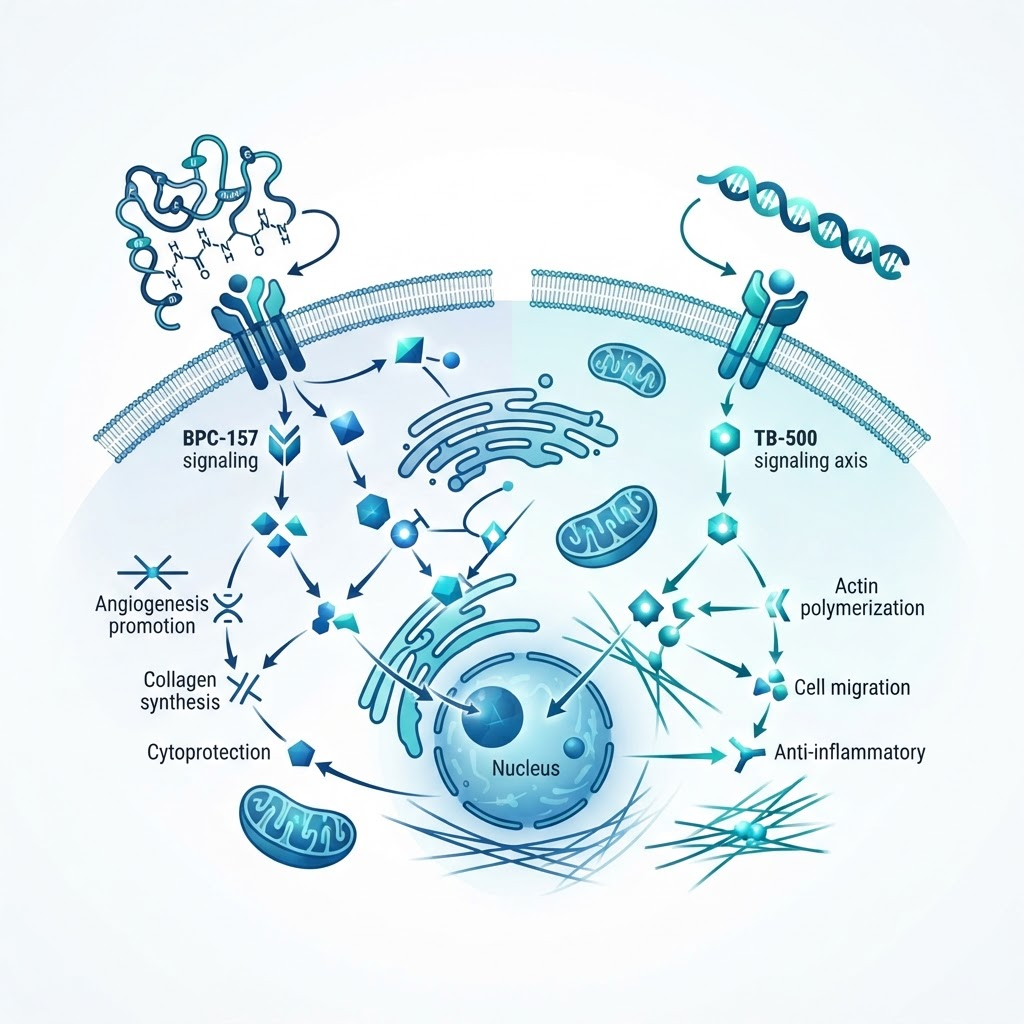
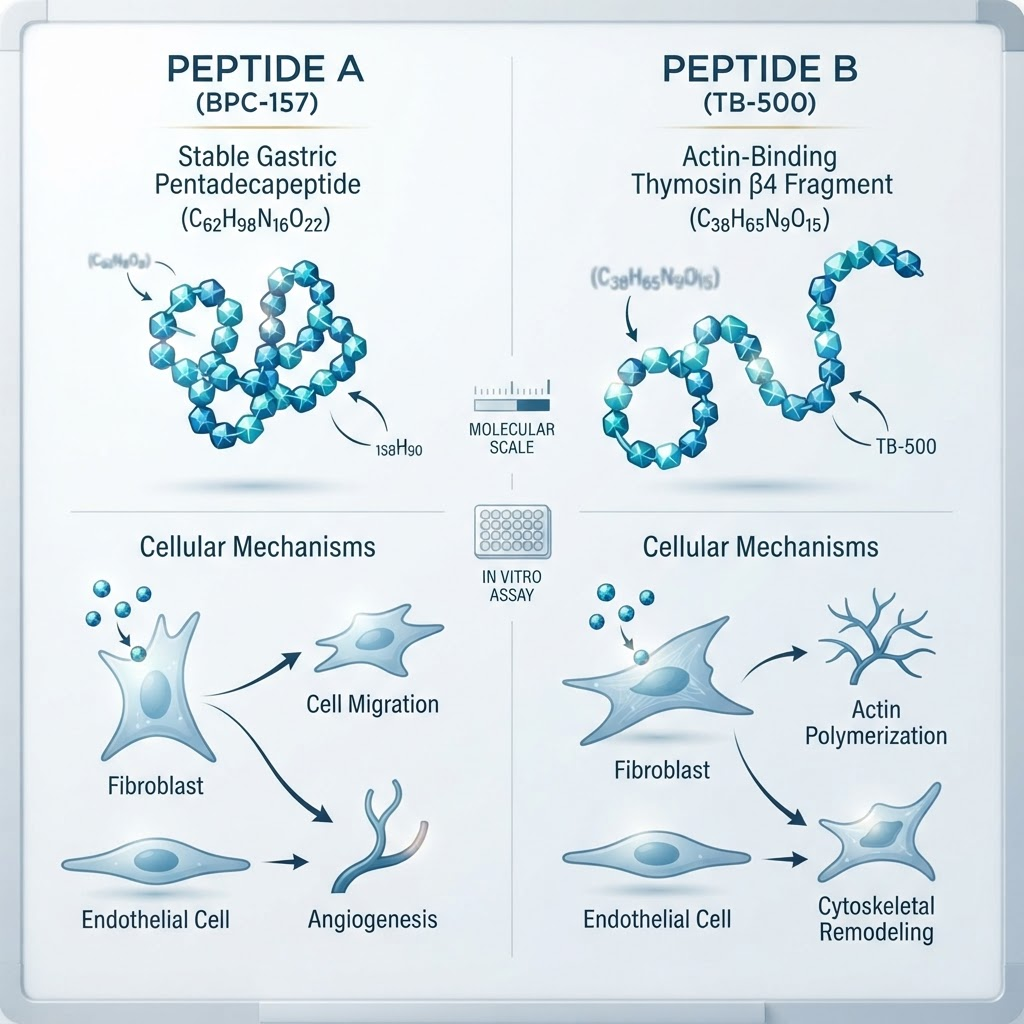
BPC-157 and TB-500 are distinct synthetic research peptides investigated in controlled cellular models. BPC-157 is a pentadecapeptide associated with a partial sequence of a gastric protein, while TB-500 is a synthetic fragment associated with thymosin beta-4 research. Comparative studies examine how each compound influences cell migration, angiogenic signaling, cytoskeletal organization, and extracellular-matrix remodeling.
This article focuses on molecular identity, receptor and pathway hypotheses, in-vitro models, analytical verification, stability, and experimental design. All compounds referenced are intended for in-vitro laboratory research only and are not intended for human or animal use.
What are BPC-157 and TB-500?
BPC-157 molecular features
BPC-157 is commonly described as a synthetic 15-residue peptide with the sequence Gly-Glu-Pro-Pro-Pro-Gly-Lys-Pro-Ala-Asp-Asp-Ala-Gly-Leu-Val. Research discussions associate it with endothelial signaling, cell migration, nitric-oxide biology, and growth-factor receptor modulation. Those proposed mechanisms should be tested rather than assumed, because observations can vary with cell type, purity, exposure time, and assay conditions.
TB-500 molecular features
TB-500 is used in research contexts as a synthetic thymosin-beta-4-related fragment. Depending on the construct and supplier nomenclature, studies may refer to short Ac-SDKP-like sequences or larger fragments. The distinction matters: sequence, terminal chemistry, molecular mass, counter-ion, and purity all influence analytical identity and biological interpretation.
| Feature | BPC-157 | TB-500 |
|---|---|---|
| Research identity | Synthetic pentadecapeptide | Synthetic thymosin-beta-4-related fragment |
| Approximate scale | About 1.4 kDa | Construct-dependent, approximately 0.9–4.9 kDa |
| Primary research themes | Endothelial, migration, nitric-oxide signaling | Actin organization, migration, matrix signaling |
| Key verification need | Sequence and mass confirmation | Exact construct and mass confirmation |
For broader context, see the [repair signaling peptide research overview](/research/repair-signaling-peptides-overview).
How do their cellular signaling hypotheses differ?
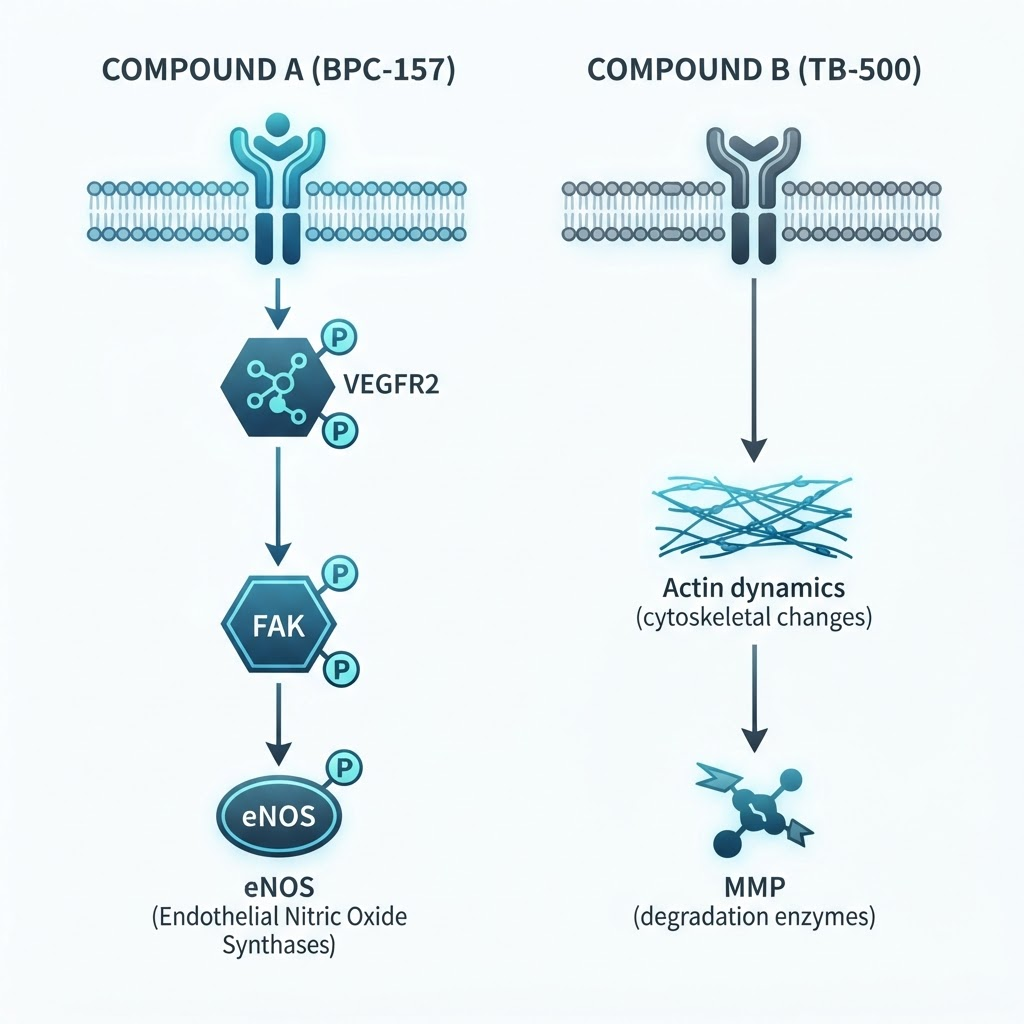
BPC-157 research commonly examines VEGFR2-associated signaling, focal-adhesion kinase phosphorylation, paxillin organization, endothelial nitric-oxide synthase activity, and interactions with growth-factor systems. These observations do not establish one universal receptor target. Receptor blocking, knockdown, ligand-binding, and time-course experiments are needed to separate direct signaling from secondary changes in cell state.
TB-500 research is more often framed around actin-associated biology. Thymosin-beta-4-related sequences can be studied through actin organization, cytoskeletal remodeling, cell polarization, migration, and downstream matrix markers. Some experimental systems also examine VEGF-associated signaling and matrix metalloproteinase expression. The precise response depends on the construct, concentration, cell model, and exposure window.
| Signaling question | BPC-157 research | TB-500 research |
|---|---|---|
| Endothelial signaling | VEGFR2, eNOS, FAK hypotheses | Indirect vascular and migration hypotheses |
| Cytoskeletal organization | Secondary migration readout | Actin-associated primary research theme |
| Cell migration | Scratch, transwell, and adhesion assays | Scratch, transwell, and polarization assays |
| Matrix remodeling | MMP and extracellular-matrix markers | MMP, collagen, and fibronectin markers |
| Confirmation strategy | Inhibitors, knockdown, phosphoproteins | Construct controls, imaging, and pathway inhibitors |
Which in-vitro models are useful?
Scratch-wound assays measure collective migration across a defined gap. Transwell or Boyden-chamber assays measure movement through a porous membrane and can be adapted for chemotaxis. These assays should include imaging at multiple time points, cell-viability controls, and normalization for proliferation so that closure is not misread as migration alone.
Endothelial tube-formation models provide a screening system for network organization. Researchers may complement them with three-dimensional matrix models, aortic-ring work, or co-culture systems. Fibroblast models help examine matrix deposition, collagen-gel contraction, and MMP activity. Epithelial models can add a barrier or polarity perspective.
| Model | Typical endpoint | Important control |
|---|---|---|
| Dermal fibroblast | Migration and matrix markers | Cell density and passage range |
| Endothelial cell | Network length and branch points | Matrix lot and seeding density |
| Epithelial cell | Closure and barrier markers | Proliferation normalization |
| Collagen gel | Contraction and matrix organization | Gel concentration and pH |
Concentration and duration must be established empirically for each model. A useful design begins with a concentration-response screen, followed by a time course that separates early phosphorylation from later transcriptional or morphological changes. Measurements should be reported in molar units rather than mass alone.
How is compound identity verified?
Reverse-phase HPLC on a C18 column provides a purity profile and can reveal major by-products. Retention time is not sufficient as a standalone identity test, so LC-MS or MALDI-TOF should be used to confirm expected molecular mass. Tandem MS can provide additional sequence evidence when the construct and instrument method support it.
Amino-acid analysis can support composition testing, while peptide-content assays distinguish peptide mass from total vial mass. For cell culture work, endotoxin testing is important because endotoxin can change cytokine and migration readouts independently of the research compound. Batch records should include chromatograms, mass spectra, peptide content, endotoxin findings, storage conditions, and the exact construct name.
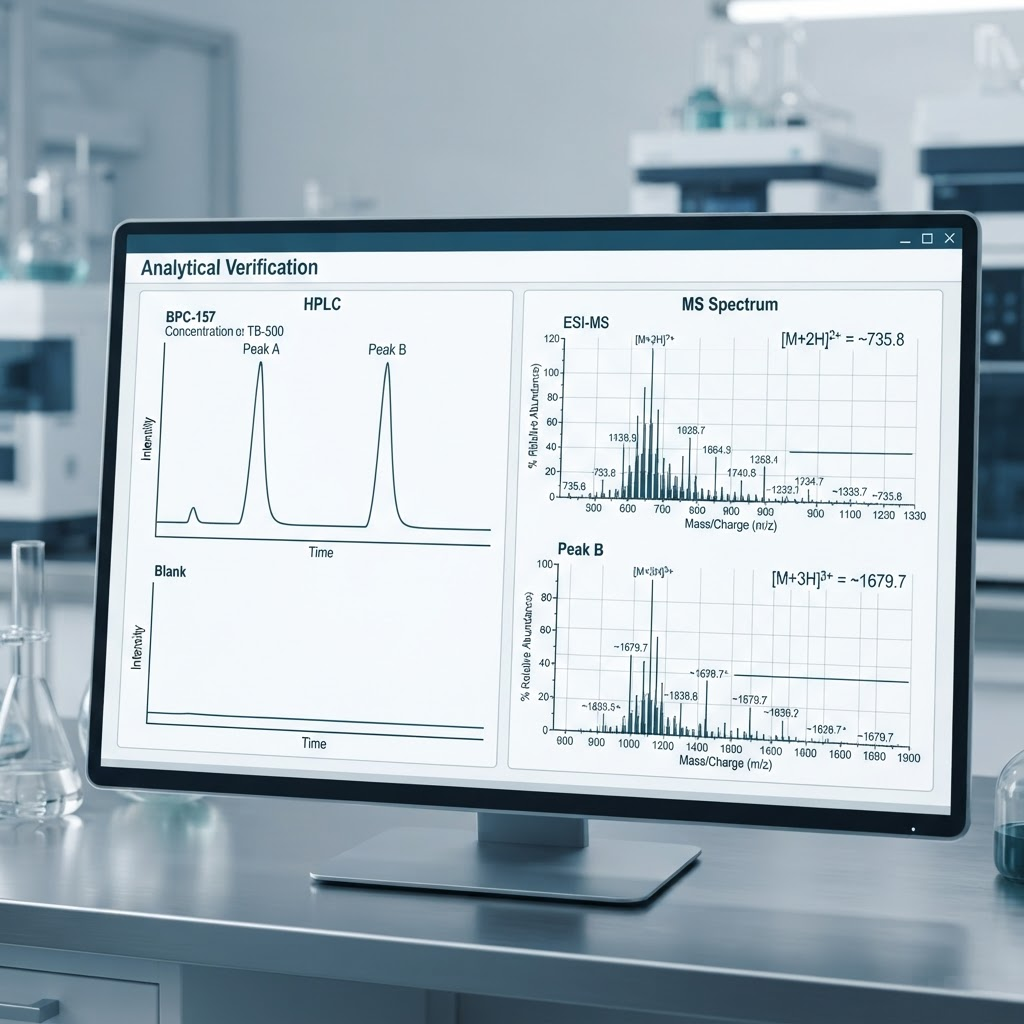
For method context, see the [HPLC chromatography guide](/blog/hplc-chromatography-guide) and [peptide purity testing standards](/blog/peptide-purity-testing-standards).
What stability variables matter?
Both compounds require controlled handling. Temperature excursions, repeated freeze-thaw events, adsorption to container surfaces, pH, oxidation, and proteolysis can alter the measured concentration. Lyophilised material should remain sealed and documented. Reconstituted material should be aliquoted when the study design permits and should not be repeatedly warmed and cooled.
A stability study can compare freshly prepared and stored samples with HPLC and mass spectrometry at defined intervals. Buffer composition, ionic strength, concentration, container type, and headspace should be recorded. If a cell-based signal changes over time, analytical data can help distinguish biological variability from compound degradation.
How should a comparative experiment be designed?
Start by defining the biological question and primary endpoint. If the question concerns migration, predefine gap closure, transwell count, imaging interval, and normalization method. If the question concerns pathway signaling, define phosphoproteins, collection times, loading controls, and inhibitor conditions before beginning.
Use untreated, vehicle, positive, and inactive-sequence controls where appropriate. A scrambled-peptide control can help assess sequence-specific activity, but it should be matched for composition, length, terminal chemistry, and purity as closely as possible. Randomization, blinded image analysis, independent biological replicates, and a prespecified exclusion rule improve interpretability.
| Design variable | Recommended documentation |
|---|---|
| Cell source | Species, donor, passage, authentication |
| Compound | Exact sequence or construct, batch, purity, mass |
| Exposure | Molar concentration, duration, medium |
| Endpoint | Assay definition, instrument, analysis rule |
| Replication | Biological and technical replicate count |
| Statistics | Model, contrasts, correction, effect estimate |
Do not combine batches without equivalence testing. Do not infer a long-term structural change from a single acute phosphorylation measurement. Likewise, a migration result should not be interpreted as proof of a specific receptor interaction without receptor-level evidence.
What are common interpretation errors?
Common errors include using a product label as a substitute for analytical identity, comparing unequal molar concentrations, omitting vehicle controls, relying on one assay, and pooling data from different cell passages. Serum composition and matrix lot can also create substantial variation. Researchers should report negative findings, assay limitations, and any deviations from the original design.
In-vitro observations are model-specific. A result in a mouse myoblast line may not translate to primary human endothelial cells, and a short peptide fragment may not behave like full-length thymosin beta-4. Clear construct naming and careful claims keep the literature reproducible.
What are emerging research directions?
Current directions include receptor knockdown, phosphoproteomic profiling, live-cell migration imaging, three-dimensional matrix models, organoid-adjacent systems, and comparative analysis across species. Multi-omic studies can connect pathway activation with transcriptional and matrix outcomes, while standardized reference batches may improve inter-laboratory comparison.
Combination experiments can be scientifically useful when they use factorial designs rather than simple co-exposure. A factorial design can distinguish independent, additive, and interaction terms. It should include single-compound arms, combined arms, matched vehicle controls, and enough independent replicates to estimate uncertainty.
Related research and products
Related research includes [peptide signaling in dermal cell research](/blog/peptide-signaling-dermal-cell-research), [collagen peptide fragments in connective tissue research](/blog/collagen-peptide-fragments-connective-tissue), [peptides in longevity research](/blog/peptides-longevity-senescence-research), [BPC-157 cellular analysis](/blog/bpc-157-cellular-analysis-breakthrough), [cell signaling research](/research/cell-signaling), and [lab accessories research](/research/lab-accessories).
Relevant laboratory product pages include [BPC-157 5mg](/product/bpc-157-5mg), [thymosin beta-4 5mg](/product/thymosin-beta-4-5mg-tb500), [thymosin beta-4 2mg](/product/thymosin-beta-4-2mg-tb500), [GHK-Cu 50mg](/product/ghk-cu-50mg-copper-peptide), [bacteriostatic mixing water](/product/10ml-bacteriostatic-mixing-water), and [acetic acid peptide solvent](/product/10ml-acetic-acid-0-6-percent-peptide-solvent).
Frequently asked questions
What are BPC-157 and TB-500?
BPC-157 is a synthetic pentadecapeptide, while TB-500 is a synthetic thymosin-beta-4-related fragment. Both are studied in controlled laboratory models.
What is the main mechanistic distinction?
BPC-157 research often examines endothelial and focal-adhesion signaling. TB-500 research often examines actin-associated cytoskeletal organization. Both require construct-specific verification.
Which models are used?
Scratch, transwell, tube-formation, matrix-contraction, proliferation, imaging, and phosphoprotein assays are common choices.
How is purity checked?
HPLC supports purity profiling, while mass spectrometry confirms expected molecular mass and LC-MS/MS can provide sequence evidence.
Why are controls important?
Controls distinguish sequence-specific signals from vehicle, matrix, serum, endotoxin, and assay artifacts.
Can the compounds be studied together?
Yes, if the design includes matched single-compound arms, combined exposure, suitable controls, and a prespecified interaction analysis.
Conclusion
BPC-157 and TB-500 represent distinct research materials with overlapping areas of cellular investigation but different identity and mechanistic questions. Reliable comparison depends on exact construct naming, analytical verification, matched molar conditions, relevant cell models, time-resolved endpoints, and transparent controls. These materials are intended for in-vitro laboratory research only and are not intended for human or animal use.
References
- Sikiric P, Seiwerth S, Rucman R, et al. Stable gastric pentadecapeptide BPC 157: novel gastric research model. Current Pharmaceutical Design. 2014.
- Goldstein AL, Hannappel E, Kleinman HK. Thymosin beta4: actin-sequestering protein moonlights to repair injured tissues. Trends in Molecular Medicine. 2005.
- Seiwerth S, Brcic L, Vuletic LB, et al. BPC 157 and blood vessels. Current Pharmaceutical Design. 2018.
- Huff T, Otto AM, Muller CS, et al. Thymosin beta4 and extracellular matrix interactions. FASEB Journal. 2001.
Frequently asked questions
What are BPC-157 and TB-500?
BPC-157 is a synthetic pentadecapeptide, while TB-500 is a synthetic thymosin-beta-4-related fragment. Both are studied in controlled laboratory models.
What is the main mechanistic distinction?
BPC-157 research often examines endothelial and focal-adhesion signaling. TB-500 research often examines actin-associated cytoskeletal organization. Both require construct-specific verification.
Which models are used?
Scratch, transwell, tube-formation, matrix-contraction, proliferation, imaging, and phosphoprotein assays are common choices.
How is purity checked?
HPLC supports purity profiling, while mass spectrometry confirms expected molecular mass and LC-MS/MS can provide sequence evidence.
Why are controls important?
Controls distinguish sequence-specific signals from vehicle, matrix, serum, endotoxin, and assay artifacts.
Can the compounds be studied together?
Yes, if the design includes matched single-compound arms, combined exposure, suitable controls, and a prespecified interaction analysis.
Frequently Asked Questions
What are BPC-157 and TB-500?
BPC-157 is a synthetic pentadecapeptide, while TB-500 is a synthetic thymosin-beta-4-related fragment. Both are studied in controlled laboratory models.
What is the main mechanistic distinction?
BPC-157 research often examines endothelial and focal-adhesion signaling. TB-500 research often examines actin-associated cytoskeletal organization. Both require construct-specific verification.
Which models are used?
Scratch, transwell, tube-formation, matrix-contraction, proliferation, imaging, and phosphoprotein assays are common choices.
How is purity checked?
HPLC supports purity profiling, while mass spectrometry confirms expected molecular mass and LC-MS/MS can provide sequence evidence.
Why are controls important?
Controls distinguish sequence-specific signals from vehicle, matrix, serum, endotoxin, and assay artifacts.
Can the compounds be studied together?
Yes, if the design includes matched single-compound arms, combined exposure, suitable controls, and a prespecified interaction analysis.
Dr Sarah Chen
Our research team combines expertise in biochemistry, skincare science, and sports medicine to bring you evidence-based peptide information.
Ready to Explore Peptides?
Discover our selection of research-grade peptides and start your optimisation journey today.
Shop Peptides