# Marine Collagen Peptide Fractions: Analytical Comparison
Marine collagen peptide fractions are size-defined subpopulations of hydrolysed fish collagen, separated by molecular weight or hydrophobicity. Unlike bulk hydrolysed collagen, fractions offer defined composition, reproducible behaviour in in-vitro models, and better analytical characterisation. They are increasingly used in research where consistency and defined properties matter more than total yield.
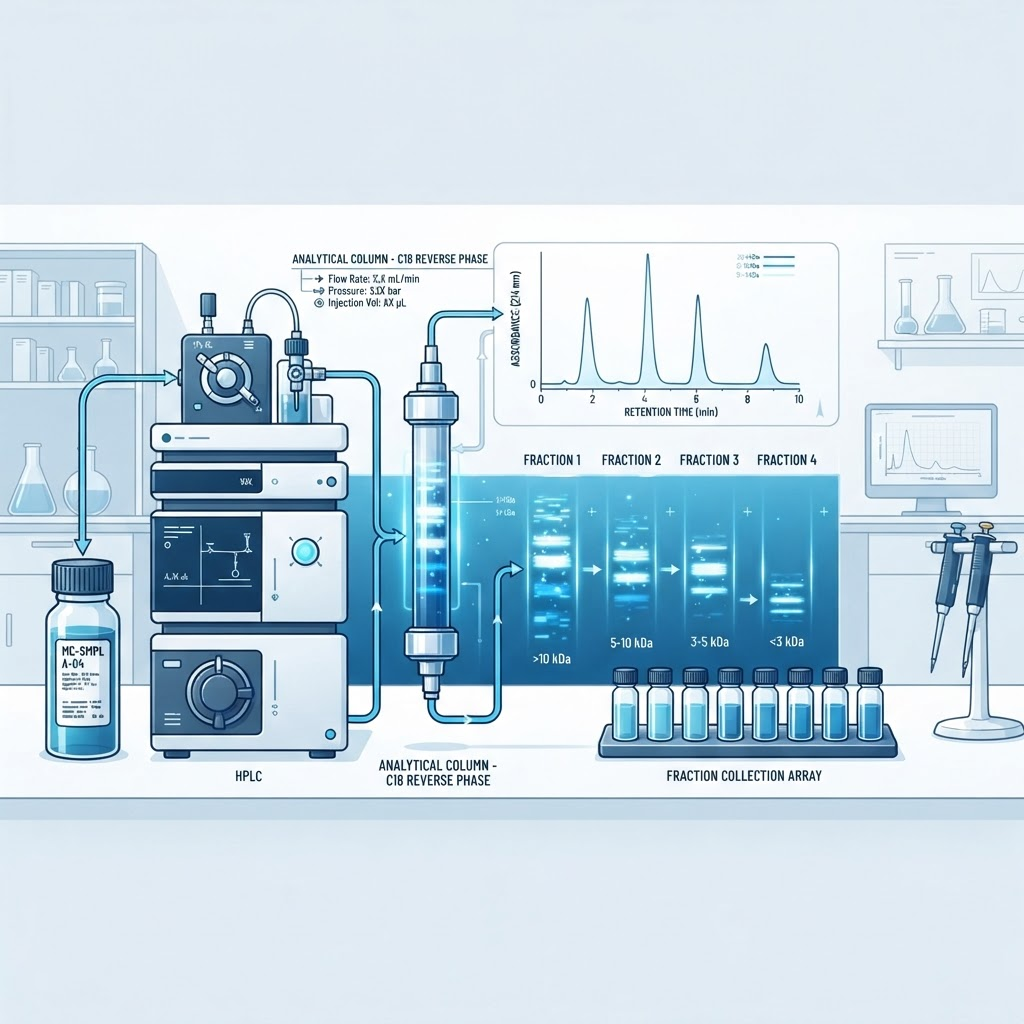
This overview covers the fractionation methods, analytical characterisation approaches, purity assessment, and experimental considerations for marine collagen peptide fractions. All materials referenced are intended for in-vitro laboratory research only.
What are marine collagen peptide fractions?
Marine collagen peptide fractions are subpopulations of peptides obtained from hydrolysed marine collagen, separated by defined physicochemical properties.
Basis of fractionation
Fractions are typically separated by:
- Molecular weight — size exclusion chromatography (SEC)
- Hydrophobicity — reverse-phase HPLC (RP-HPLC)
- Charge — ion exchange chromatography (IEC)
- Affinity — receptor or antibody-based capture
Each fraction has a narrower molecular weight or compositional range than the parent hydrolysate.
Typical fraction ranges
| Fraction | Molecular Weight Range | Characteristics |
|---|---|---|
| F1 (low MW) | 200–500 Da | Di- and tripeptides |
| F2 (medium MW) | 500 Da – 3 kDa | Oligopeptides |
| F3 (high MW) | 3–10 kDa | Polypeptides |
| F4 (bulk) | >10 kDa | Partial helical fragments |
Each fraction may show different cellular responses. Fraction selection depends on the research question.
For a broader context, see [Marine vs. Bovine Collagen: Source Comparison for Laboratory Studies](/blog/marine-vs-bovine-collagen-lab-comparison).
Why fractionate marine collagen?
Fractionation addresses limitations of bulk hydrolysed collagen:
Consistency
Bulk hydrolysates show batch-to-batch variability in molecular weight distribution. Fractions reduce this variability within a defined range.
Reproducibility
Defined fractions give more reproducible assay readouts in cell-based assays. Researchers can compare across labs with confidence.
Mechanistic studies
Specific fractions can be tested against specific receptors or pathways. This is not possible with unfractionated mixtures.
Analytical verification
Fractions are easier to characterise analytically. HPLC traces are simpler, and mass spectrometry is more interpretable.
Regulatory and documentation
Defined fractions have clearer documentation for research protocols. Batch-specific CoA documentation is more meaningful.
How are marine collagen fractions produced?
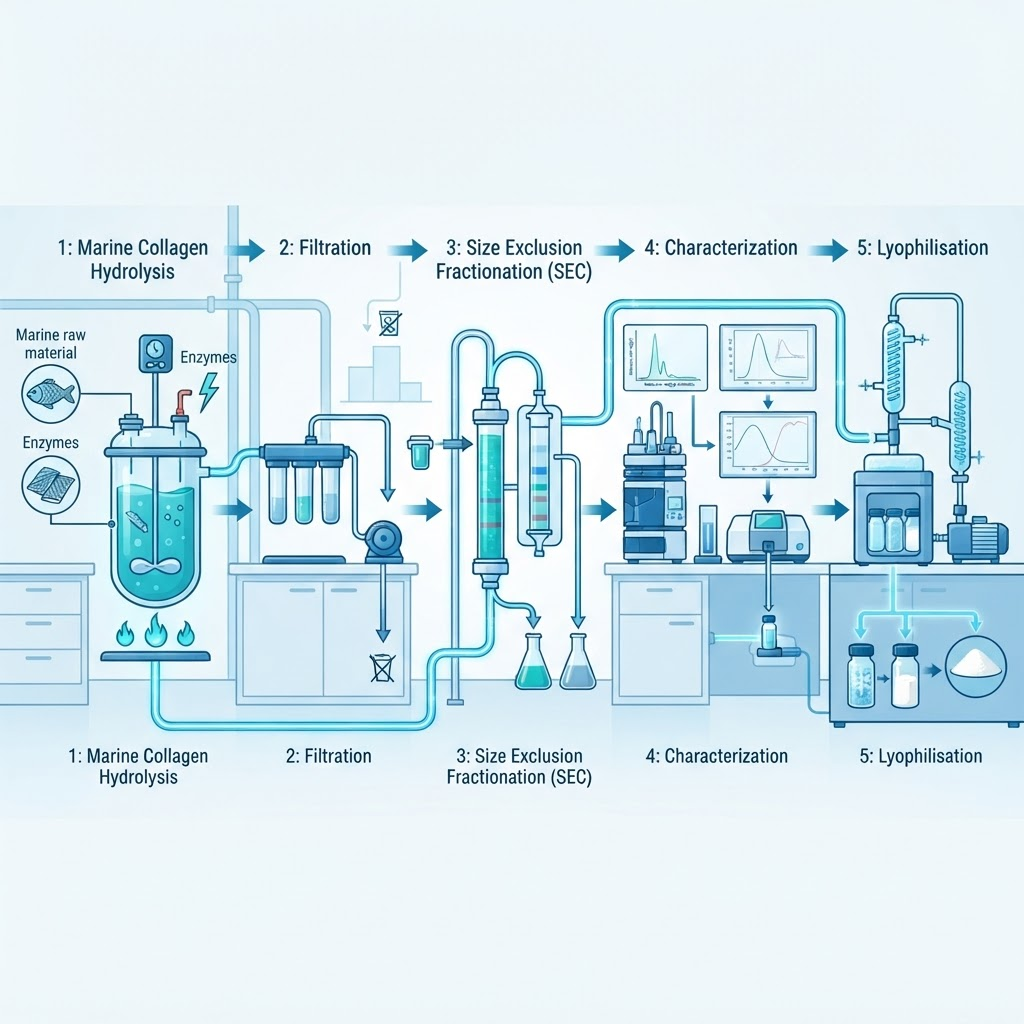
Fractionation follows a defined workflow:
Step 1 — Hydrolysis
Marine collagen is hydrolysed by:
- Enzymatic hydrolysis — using pepsin, papain, or alcalase
- Acid hydrolysis — using dilute HCl or acetic acid
- Alkaline hydrolysis — using NaOH
- Combined methods — sequential enzymatic and chemical
Enzymatic hydrolysis is preferred for research because it preserves specific sequences.
Step 2 — Initial separation
The hydrolysate is clarified by:
- Centrifugation
- Filtration (0.22 µm or 0.45 µm)
- Ultrafiltration (defined MWCO membranes)
Step 3 — Fractionation
Size-based fractionation uses:
- Size exclusion chromatography (SEC) — separates by hydrodynamic volume
- Ultrafiltration — sequential membranes with defined MWCO
- Dialysis — for removing low MW species
Hydrophobicity-based fractionation uses reverse-phase HPLC with a C18 column and acetonitrile gradient.
Step 4 — Characterisation
Each fraction is characterised by:
- Amino acid analysis
- HPLC purity assessment
- Mass spectrometry (LC-MS/MS for sequence identification)
- Molecular weight distribution (SEC or MALDI-TOF)
Step 5 — Lyophilisation
Fractions are lyophilised and stored at -20°C or -80°C in sealed vials.
What analytical methods characterise marine collagen fractions?
Multiple methods are required for full characterisation.
Amino acid analysis
Quantifies molar ratio of each amino acid. Marine collagen is characterised by:
- Glycine ~33%
- Proline 9–12%
- Hydroxyproline 6–10%
- Alanine 8–10%
Deviation indicates contamination or incorrect source.
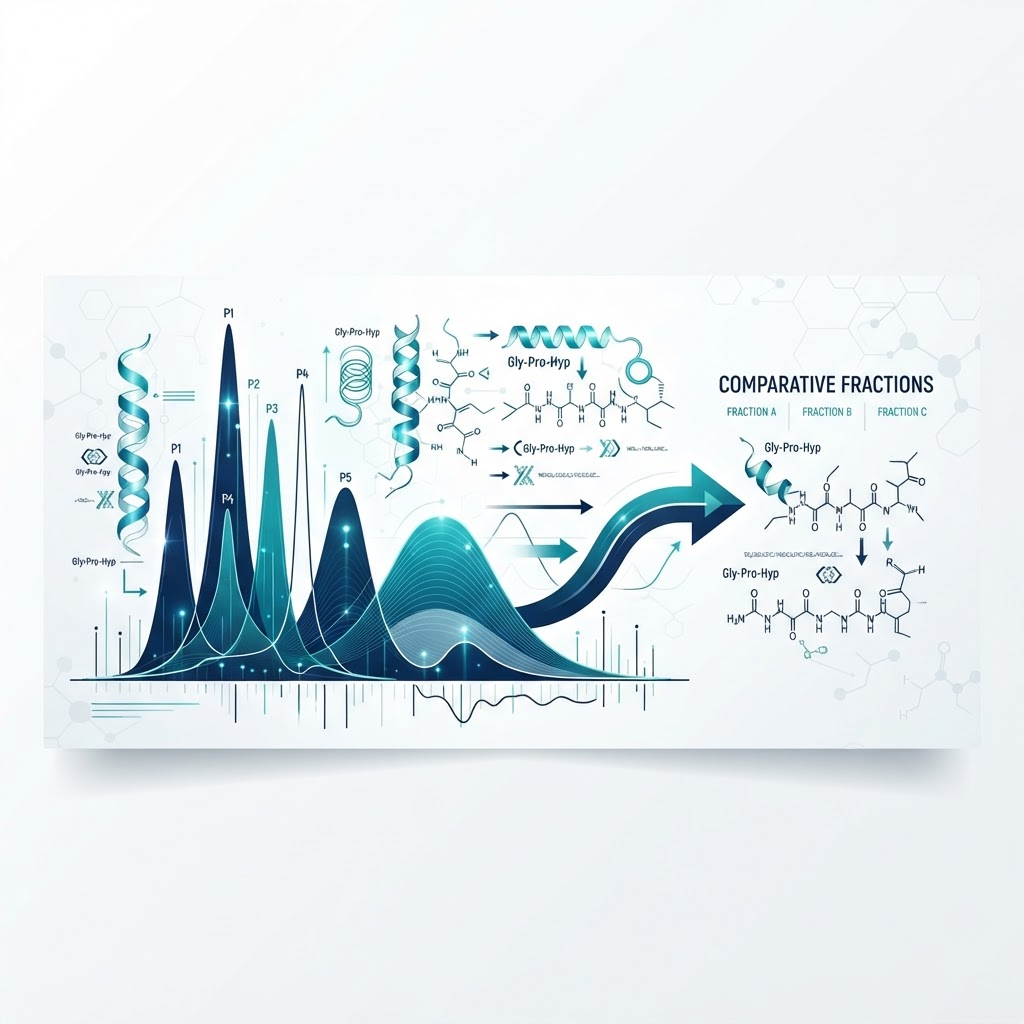
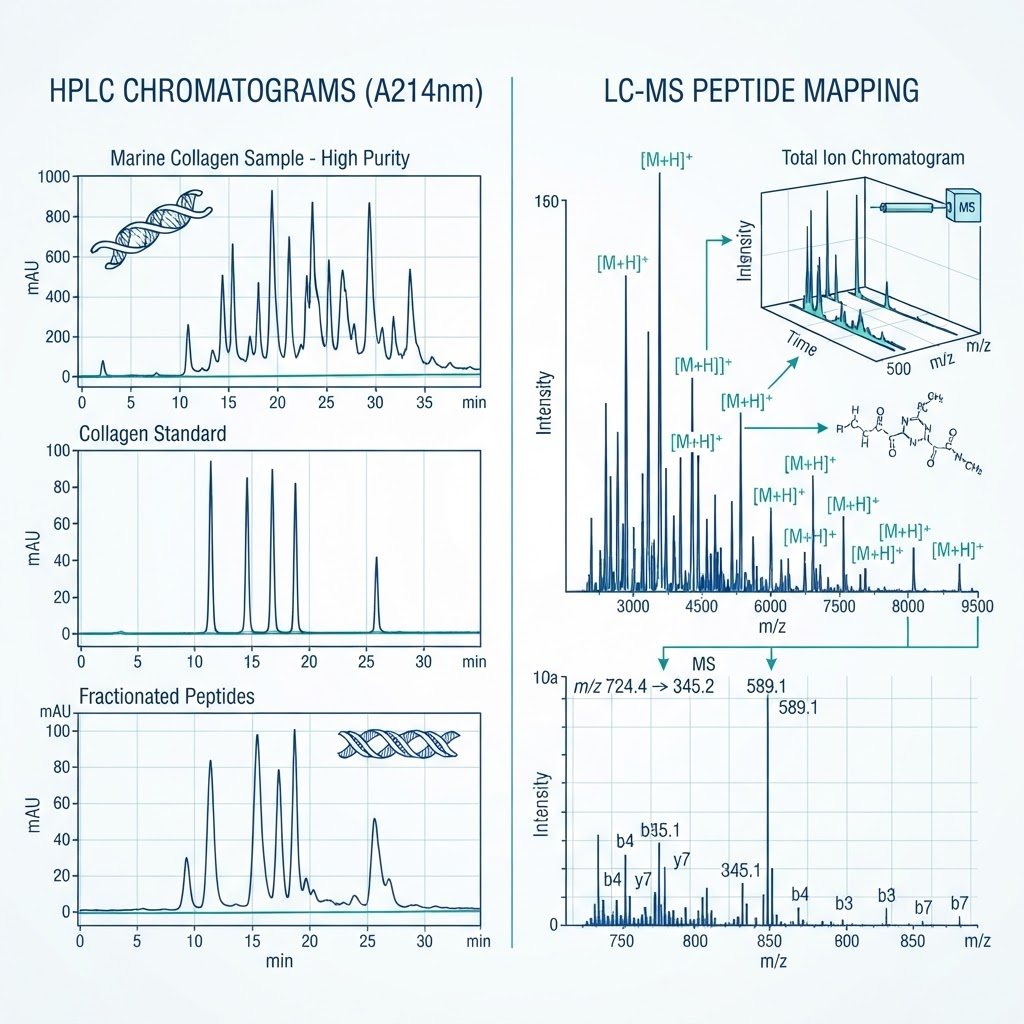
HPLC
Reverse-phase HPLC assesses purity and hydrophobicity profile. Purity is expressed as the percentage of total peak area.
For a full guide, see [HPLC Chromatography Guide](/blog/hplc-chromatography-guide) and [Peptide Purity Testing Standards](/blog/peptide-purity-testing-standards).
Mass spectrometry
LC-MS/MS identifies specific peptide sequences. MALDI-TOF provides rapid mass profiling. This confirms fraction identity and detects unexpected components.
Size exclusion chromatography
Determines molecular weight distribution within the fraction. This is the primary method for confirming that fractionation succeeded.
Hydroxyproline assay
Specific to collagen. Quantifies total collagen content. Useful for comparing fractions on a per-collagen basis.
What are the purity considerations?
Purity of marine collagen fractions is assessed at multiple levels:
Peptide purity
The percentage of the fraction represented by collagen-derived peptides. Non-collagen peptides (from co-extracted proteins) reduce purity.
Molecular weight purity
The narrowness of the molecular weight distribution. A well-prepared fraction has a narrow distribution.
Source purity
Confirmation that the collagen is marine-derived. Amino acid profile and species-specific markers confirm source.
Endotoxin level
For cell culture, endotoxin must be <1 EU/µg. Limulus amoebocyte lysate (LAL) assay is standard.
Heavy metal content
Marine sources may accumulate heavy metals (arsenic, mercury, lead). ICP-MS testing confirms safety for research use.
How do different fractions behave in in-vitro models?
Different fractions show distinct biological activities:
| Fraction | Typical Cellular Response |
|---|---|
| F1 (low MW) | Rapid diffusion, fast cellular uptake |
| F2 (medium MW) | Receptor-mediated adhesion, moderate signaling |
| F3 (high MW) | Integrin binding, matrix synthesis support |
| F4 (bulk) | Mixed response |
For a broader discussion of collagen fragment biology, see [Collagen Peptide Fragments in Connective Tissue Research](/blog/collagen-peptide-fragments-connective-tissue).
What are the storage and stability considerations?
Marine collagen fractions are sensitive to:
| Factor | Effect | Mitigation |
|---|---|---|
| Temperature | Aggregation and degradation | Store at -20°C or -80°C |
| Moisture | Hydrolysis | Store lyophilised, sealed |
| Light | Oxidation of aromatic residues | Protect from light |
| pH | Affects charge state | Buffer appropriately when reconstituting |
| Freeze-thaw | Aggregation | Aliquot before freezing |
Stability testing
Pre-experiment stability testing:
- Reconstitute fraction in buffer or media
- Incubate at 37°C
- Sample at 0, 4, 8, 24 hours
- Analyse by SEC or HPLC
- Determine half-life
For a full guide, see [Peptide Storage and Stability Best Practices](/blog/peptide-storage-stability-science-backed-best-practices).
How do you design experiments with fractions?
Design considerations:
Concentration selection
Fraction concentration is defined by total peptide mass or by collagen content. Specify which measure is used.
Cell model selection
Match cell model to fraction type:
- Dermal fibroblasts — matrix synthesis studies
- Chondrocytes — cartilage research
- Endothelial cells — vascular studies
- Mesenchymal stem cells — differentiation studies
Timepoints
Fraction effects vary by timepoint:
- Uptake studies: 15 min – 4 hours
- Adhesion studies: 30 min – 2 hours
- Signaling studies: 15 min – 24 hours
- Matrix synthesis: 24 – 72 hours
Controls
Include:
- Unfractionated hydrolysate (comparison)
- Vehicle control
- Positive control (known active peptide)
- Negative control (scrambled sequence)
Analytical verification of fractions
Before every experiment, verify fraction identity by HPLC or SEC. Batch-specific documentation is essential.
What are common pitfalls in fraction research?
- Unverified fraction identity — assuming fractions are pure without analysis
- Batch mixing — pooling data across batches without equivalence verification
- Incorrect concentration — using total mass rather than collagen content
- Storage errors — exposing fractions to temperature fluctuations
- Contamination — failing to test for endotoxin or heavy metals
- Inconsistent reconstitution — variable solubility affecting effective concentration
- Cell passage drift — comparing data across passages
- Inadequate controls — omitting comparison to unfractionated hydrolysate
Avoiding these requires documentation and verification.
What are the emerging research applications?
Recent research areas include:
Tissue engineering
Fractions with defined properties are used as scaffold components. Defined molecular weight improves scaffold reproducibility.
Cell culture substrates
Defined fractions improve reproducibility of cell adhesion studies. This is critical for stem cell differentiation research.
Delivery systems
Fraction-specific properties are exploited in nanoparticle and hydrogel research.
Comparative biology
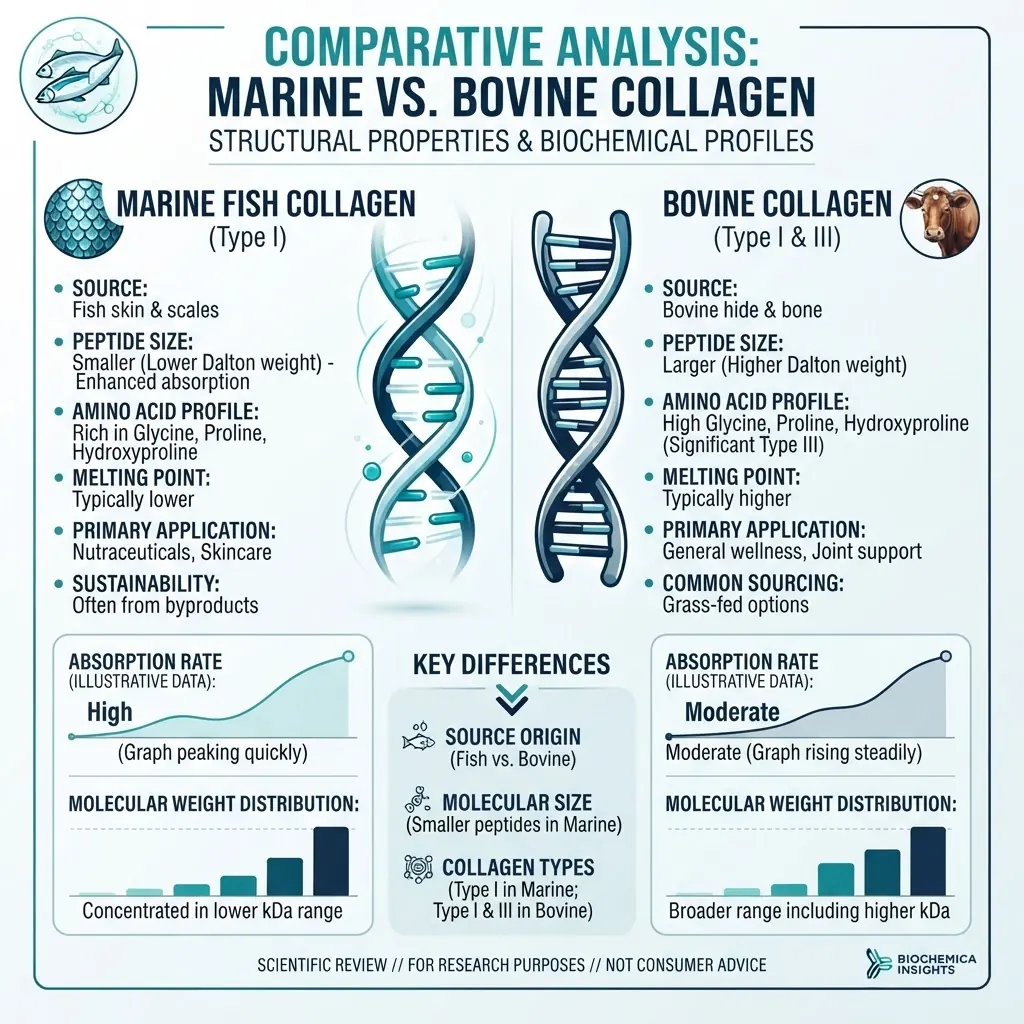
Comparing marine fractions to bovine fractions informs collagen biology research. See [Marine vs. Bovine Collagen: Source Comparison for Laboratory Studies](/blog/marine-vs-bovine-collagen-lab-comparison).
For related products, see our [Repair Signaling Peptides research category](/research/repair-signaling-peptides-overview).
Related Research and Products
Related research articles:
- [Marine vs. Bovine Collagen: Source Comparison for Laboratory Studies](/blog/marine-vs-bovine-collagen-lab-comparison)
- [Collagen Peptide Fragments in Connective Tissue Research](/blog/collagen-peptide-fragments-connective-tissue)
- [Hydrolysed Collagen Peptides: Molecular Structure and Research Applications](/blog/hydrolysed-collagen-peptides-structure)
- [HPLC Chromatography Guide](/blog/hplc-chromatography-guide)
- [Peptide Purity Testing Standards](/blog/peptide-purity-testing-standards)
- [Peptide Storage and Stability Best Practices](/blog/peptide-storage-stability-science-backed-best-practices)
Related product pages:
- [BPC-157 5mg](/product/bpc-157-5mg)
- [TB-500 (Thymosin Beta-4) 5mg](/product/thymosin-beta-4-5mg-tb500)
- [GHK-Cu 50mg Copper Peptide](/product/ghk-cu-50mg-copper-peptide)
- [Bacteriostatic Mixing Water](/product/10ml-bacteriostatic-mixing-water)
- [Acetic Acid 0.6% Peptide Solvent](/product/10ml-acetic-acid-0-6-percent-peptide-solvent)
Related research categories:
- [Repair Signaling Peptides](/research/repair-signaling-peptides-overview)
- [Cell Signaling](/research/cell-signaling)
- [Lab Accessories](/research/lab-accessories)
Frequently Asked Questions
What are marine collagen peptide fractions?
They are subpopulations of hydrolysed marine collagen, separated by molecular weight or hydrophobicity. Each fraction has a narrower compositional range than the parent hydrolysate.
Why are fractions preferred over bulk hydrolysates?
Fractions provide defined molecular weight distribution, improved reproducibility, better analytical characterisation, and more meaningful batch documentation.
How are marine collagen fractions produced?
By enzymatic hydrolysis of marine collagen, followed by size exclusion chromatography, ultrafiltration, or reverse-phase HPLC. Fractions are then characterised by HPLC, mass spectrometry, and amino acid analysis.
What analytical methods verify fraction identity?
Amino acid analysis confirms composition, HPLC confirms purity, mass spectrometry identifies specific sequences, and SEC confirms molecular weight distribution.
How should marine collagen fractions be stored?
Lyophilised fractions should be stored at -20°C or -80°C in sealed vials, protected from light and moisture. Reconstituted fractions should be aliquoted and frozen to avoid freeze-thaw cycles.
What purity level is required for cell culture studies?
Peptide purity ≥95% by HPLC is typical. Endotoxin must be <1 EU/µg. Heavy metals must be tested for marine sources.
How do different fractions behave in cell culture?
Low MW fractions show rapid diffusion and uptake. Medium MW fractions mediate receptor binding. High MW fractions support integrin binding and matrix synthesis. Fraction selection depends on the research question.
What are common pitfalls in fraction research?
Unverified fraction identity, batch mixing, incorrect concentration (using total mass vs collagen content), storage errors, contamination, and inadequate controls. Verification at every step is essential.
Conclusion
Marine collagen peptide fractions offer defined composition, improved reproducibility, and better analytical characterisation than bulk hydrolysates. Their use in laboratory research requires careful attention to fractionation methods, analytical verification, storage conditions, and experimental design. Researchers should prioritise batch-specific documentation and stability testing.
All materials referenced in this article are intended for in-vitro laboratory research only. They are not medicines, supplements, or consumer products, and are not for human or animal use.
References
- Silva TH, Moreira-Silva J, Marques ALP, et al. (2014). Marine origin collagens and its potential applications. Marine Drugs, 12(12), 5881–5901.
- Gómez-Guillén MC, Giménez B, López-Caballero ME, Montero MP. (2011). Functional and bioactive properties of collagen and gelatin from alternative sources: A review. Food Hydrocolloids, 25(8), 1813–1827.
- Shoulders MD, Raines RT. (2009). Collagen structure and stability. Annual Review of Biochemistry, 78, 929–958.
- Sato K. (2017). The presence of food-derived collagen peptides in human body and their physiological effects. Journal of Agricultural and Food Chemistry, 65(8), 1541–1547.
- Schagen SK. (2017). Topical peptide formulations with effective anti-aging properties. Cosmetics, 4(2), 16.
Frequently asked questions
What are marine collagen peptide fractions?
They are subpopulations of hydrolysed marine collagen, separated by molecular weight or hydrophobicity. Each fraction has a narrower compositional range than the parent hydrolysate.
Why are fractions preferred over bulk hydrolysates?
Fractions provide defined molecular weight distribution, improved reproducibility, better analytical characterisation, and more meaningful batch documentation.
How are marine collagen fractions produced?
By enzymatic hydrolysis of marine collagen, followed by size exclusion chromatography, ultrafiltration, or reverse-phase HPLC. Fractions are then characterised by HPLC, mass spectrometry, and amino acid analysis.
What analytical methods verify fraction identity?
Amino acid analysis confirms composition, HPLC confirms purity, mass spectrometry identifies specific sequences, and SEC confirms molecular weight distribution.
How should marine collagen fractions be stored?
Lyophilised fractions should be stored at -20°C or -80°C in sealed vials, protected from light and moisture. Reconstituted fractions should be aliquoted and frozen to avoid freeze-thaw cycles.
What purity level is required for cell culture studies?
Peptide purity ≥95% by HPLC is typical. Endotoxin must be <1 EU/µg. Heavy metals must be tested for marine sources.
How do different fractions behave in cell culture?
Low MW fractions show rapid diffusion and uptake. Medium MW fractions mediate receptor binding. High MW fractions support integrin binding and matrix synthesis. Fraction selection depends on the research question.
What are common pitfalls in fraction research?
Unverified fraction identity, batch mixing, incorrect concentration (using total mass vs collagen content), storage errors, contamination, and inadequate controls. Verification at every step is essential.
Frequently Asked Questions
What are marine collagen peptide fractions?
They are subpopulations of hydrolysed marine collagen, separated by molecular weight or hydrophobicity. Each fraction has a narrower compositional range than the parent hydrolysate.
Why are fractions preferred over bulk hydrolysates?
Fractions provide defined molecular weight distribution, improved reproducibility, better analytical characterisation, and more meaningful batch documentation.
How are marine collagen fractions produced?
By enzymatic hydrolysis of marine collagen, followed by size exclusion chromatography, ultrafiltration, or reverse-phase HPLC. Fractions are then characterised by HPLC, mass spectrometry, and amino acid analysis.
What analytical methods verify fraction identity?
Amino acid analysis confirms composition, HPLC confirms purity, mass spectrometry identifies specific sequences, and SEC confirms molecular weight distribution.
How should marine collagen fractions be stored?
Lyophilised fractions should be stored at -20°C or -80°C in sealed vials, protected from light and moisture. Reconstituted fractions should be aliquoted and frozen to avoid freeze-thaw cycles.
What purity level is required for cell culture studies?
Peptide purity ≥95% by HPLC is typical. Endotoxin must be <1 EU/µg. Heavy metals must be tested for marine sources.
How do different fractions behave in cell culture?
Low MW fractions show rapid diffusion and uptake. Medium MW fractions mediate receptor binding. High MW fractions support integrin binding and matrix synthesis. Fraction selection depends on the research question.
What are common pitfalls in fraction research?
Unverified fraction identity, batch mixing, incorrect concentration (using total mass vs collagen content), storage errors, contamination, and inadequate controls. Verification at every step is essential.
Emma Lawrence
Our research team combines expertise in biochemistry, skincare science, and sports medicine to bring you evidence-based peptide information.
Ready to Explore Peptides?
Discover our selection of research-grade peptides and start your optimisation journey today.
Shop Peptides