Disclaimer: This article is for in-vitro laboratory research only. It is not medical advice and does not describe human or animal use.
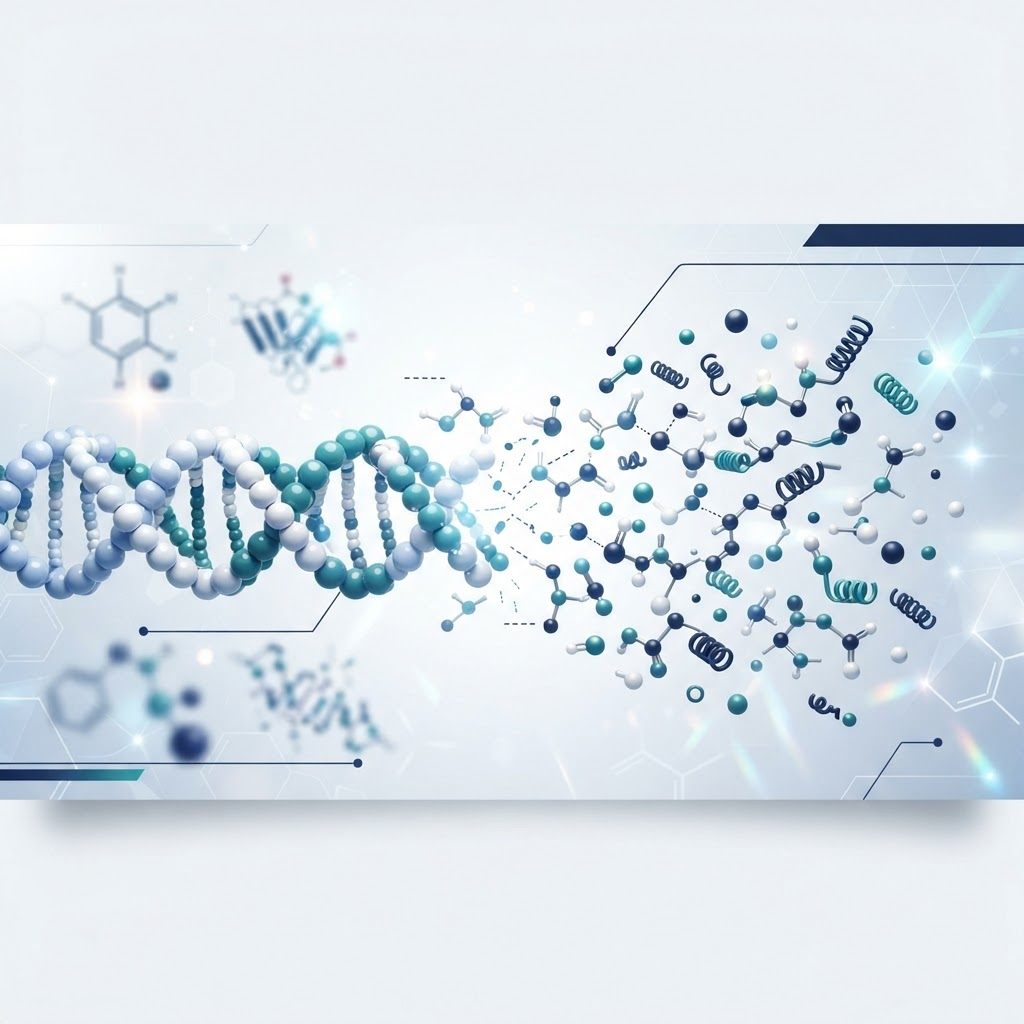
Hydrolysed collagen peptides are short-chain fragments produced by the chemical or enzymatic cleavage of native collagen. Hydrolysis disrupts the triple-helical structure and produces a mixture with altered solubility, molecular-weight distribution, charge, and sequence presentation. Understanding these changes is essential when interpreting in-vitro research or designing reproducible experiments.
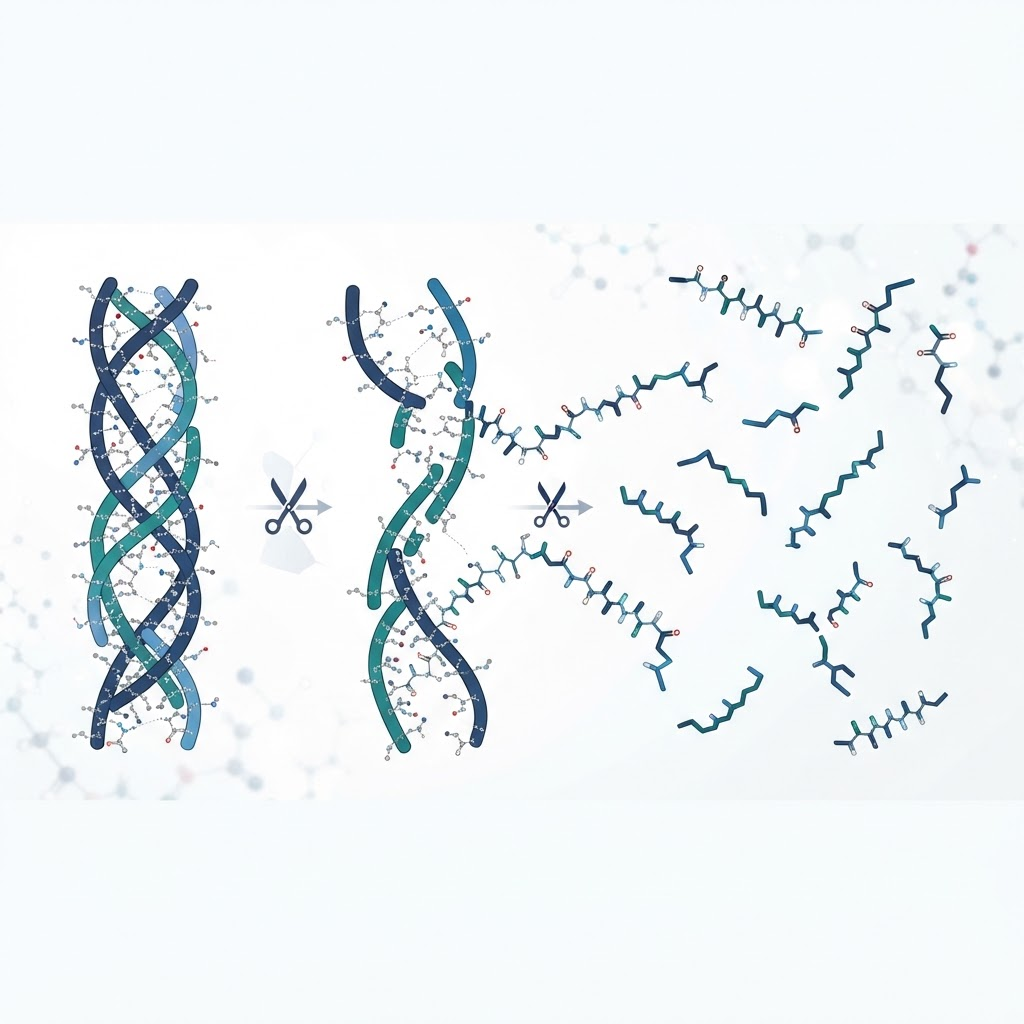
This overview covers hydrolysis methods, resulting molecular-weight distributions, structural characterisation, analytical verification, solution behaviour, and in-vitro research applications. All materials referenced are intended for in-vitro laboratory research only.
What is hydrolysed collagen?
Hydrolysed collagen is native collagen that has been chemically or enzymatically cleaved into shorter peptide chains. Native fibrillar collagen is built from three polypeptide chains arranged in a repeating Gly-X-Y sequence and has an apparent molecular mass near 300 kDa. Hydrolysis introduces new N- and C-termini and can produce fragments from several hundred daltons to several kilodaltons.
The principal structural changes are triple-helix disruption, lower average molecular weight, increased aqueous solubility, altered terminal charge, and exposure of new reactive groups. These changes influence diffusion, adsorption, aggregation, and how a preparation behaves in a cell-based assay.
Main hydrolysis approaches
| Method | Mechanism | Research characteristics |
|---|---|---|
| Acid hydrolysis | Mineral or organic acid at elevated temperature | Broad cleavage and heterogeneous products |
| Alkaline hydrolysis | Strong base at elevated temperature | Broad cleavage with racemisation risk |
| Enzymatic hydrolysis | Protease-mediated peptide-bond cleavage | More selective and generally more reproducible |
Enzymatic processing is often selected for research preparations because enzyme specificity, reaction time, pH, and temperature can be documented and controlled. The final distribution still requires independent measurement; an enzyme name alone does not define the composition of a batch.
For related structural context, see [Collagen Peptide Fragments in Connective Tissue Research](/blog/collagen-peptide-fragments-connective-tissue).
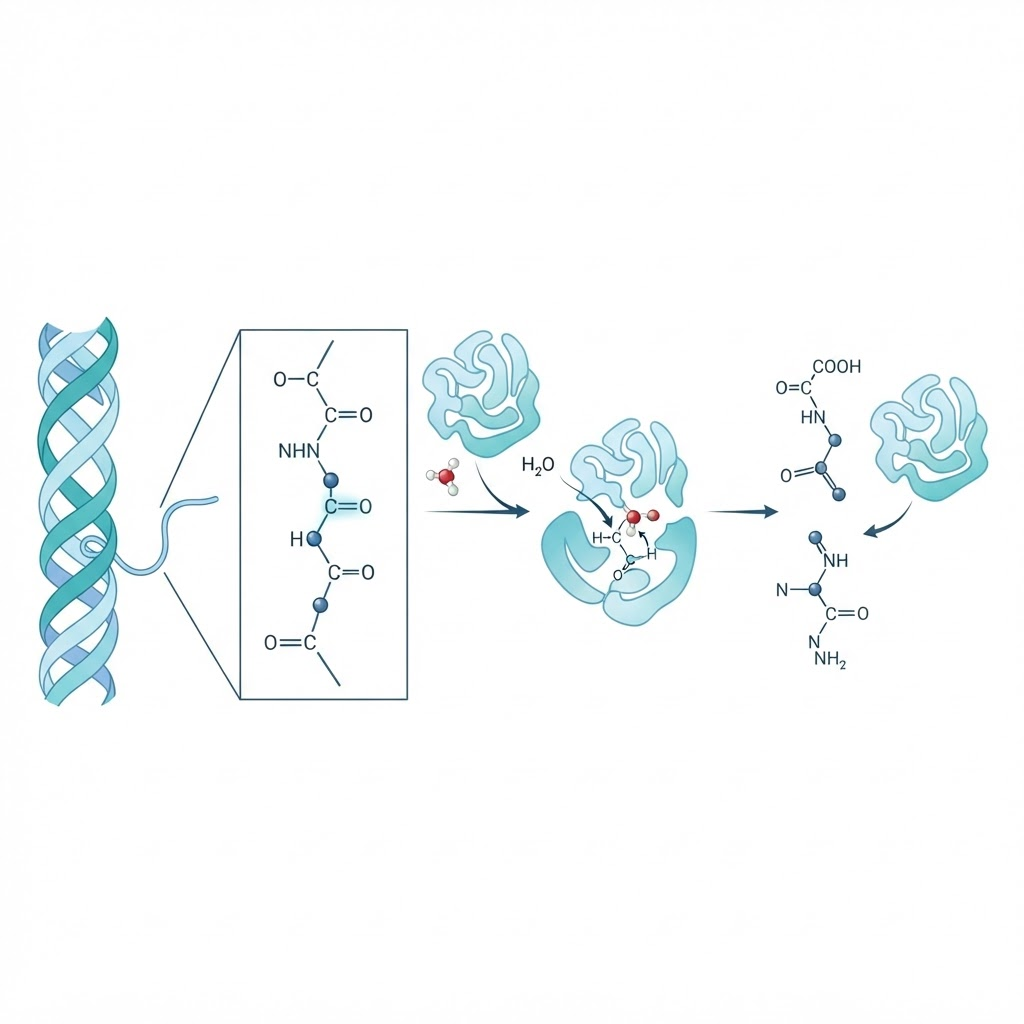
How does hydrolysis work at the molecular level?
Hydrolysis uses water to cleave peptide bonds in the collagen backbone. Acid conditions can favour cleavage near acid-labile sequences and may destroy sensitive residues such as tryptophan. Alkaline conditions can cause deamidation, oxidation, and amino-acid racemisation. Enzymes provide a different route: their active sites recognise local sequence or conformational features and release fragments according to the chosen protease and reaction conditions.
Common research enzymes include pepsin, papain, alcalase, collagenase, and trypsin. Pepsin can release relatively large telopeptide-poor fragments, while broad-specificity proteases generally produce wider mixtures of shorter peptides. Collagenase is useful when the experimental question concerns collagen-rich sequence regions, but the resulting products still require chromatographic and mass-spectrometric confirmation.
A useful process descriptor is the degree of hydrolysis, which estimates the proportion of peptide bonds cleaved relative to the starting material. It should be reported with the assay used, because different analytical methods can produce different apparent values. Increasing hydrolysis usually shifts the distribution toward smaller fragments, but it does not necessarily create a narrow or sequence-defined preparation.
What is the molecular-weight distribution?
Molecular-weight distribution is one of the most important descriptors of a hydrolysed collagen preparation. Two materials described as collagen hydrolysate may differ substantially in peak mass, dispersity, sequence composition, and residual high-mass content.
| Preparation | Approximate range | Typical interpretation |
|---|---|---|
| Native collagen | About 300 kDa | Intact triple-helical protein |
| Partially hydrolysed collagen | 10–50 kDa | Larger fragments and partially disrupted material |
| Standard hydrolysate | 1–10 kDa | Broad peptide mixture |
| Low-molecular-weight hydrolysate | 0.2–3 kDa | Enriched in short fragments |
| Very-low-molecular-weight fraction | 0.2–0.5 kDa | Small fragments and free amino-acid-rich material |
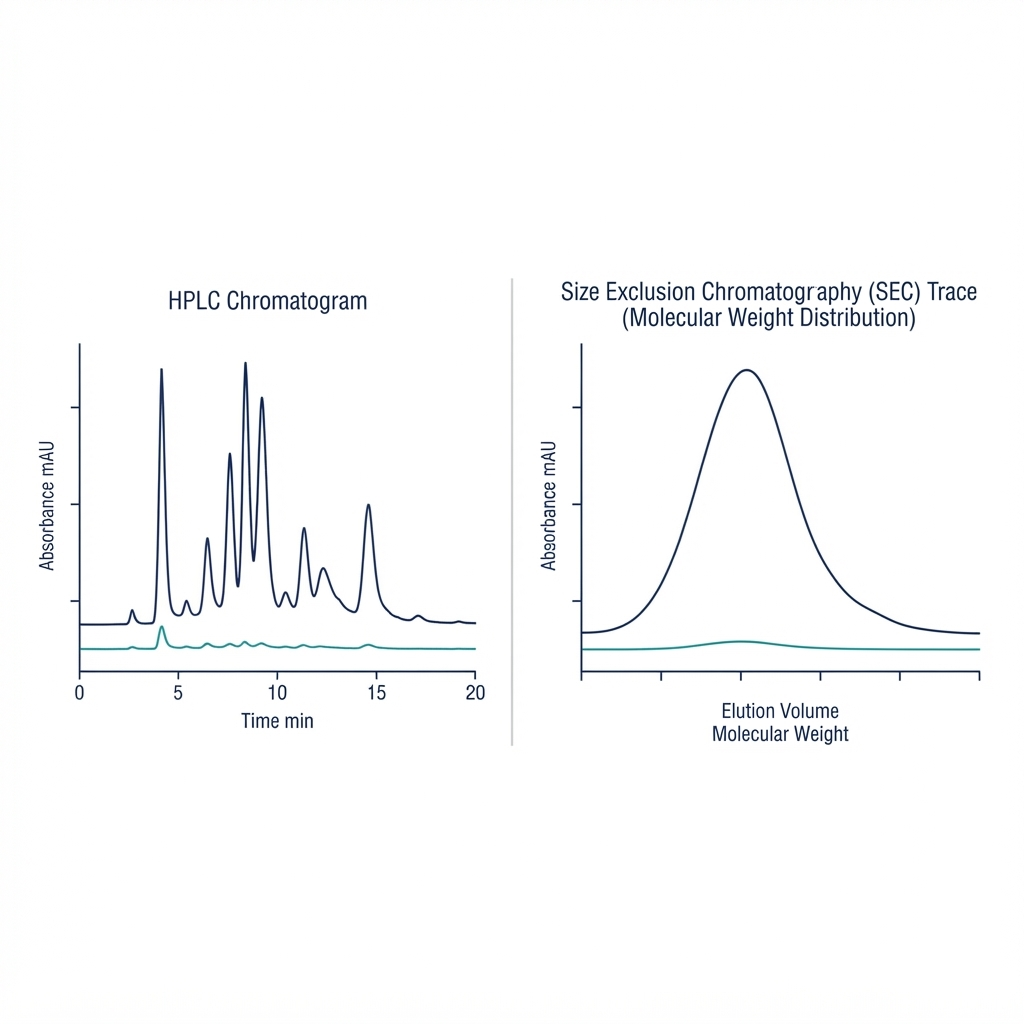
Size-exclusion chromatography estimates a distribution according to hydrodynamic volume. SDS-PAGE can visualise larger fragments, while MALDI-TOF and LC-MS/MS provide mass and sequence information. No single method fully describes a complex hydrolysate, so orthogonal methods are preferred when batch identity matters.
Molecular size can influence dissolution rate, diffusion in culture media, adsorption to plastic, aggregation, and apparent activity in cell-based assays. These observations should not be generalised across sources or batches without measurement. Report concentration basis, solvent, pH, temperature, mixing conditions, and the analytical method alongside any result.
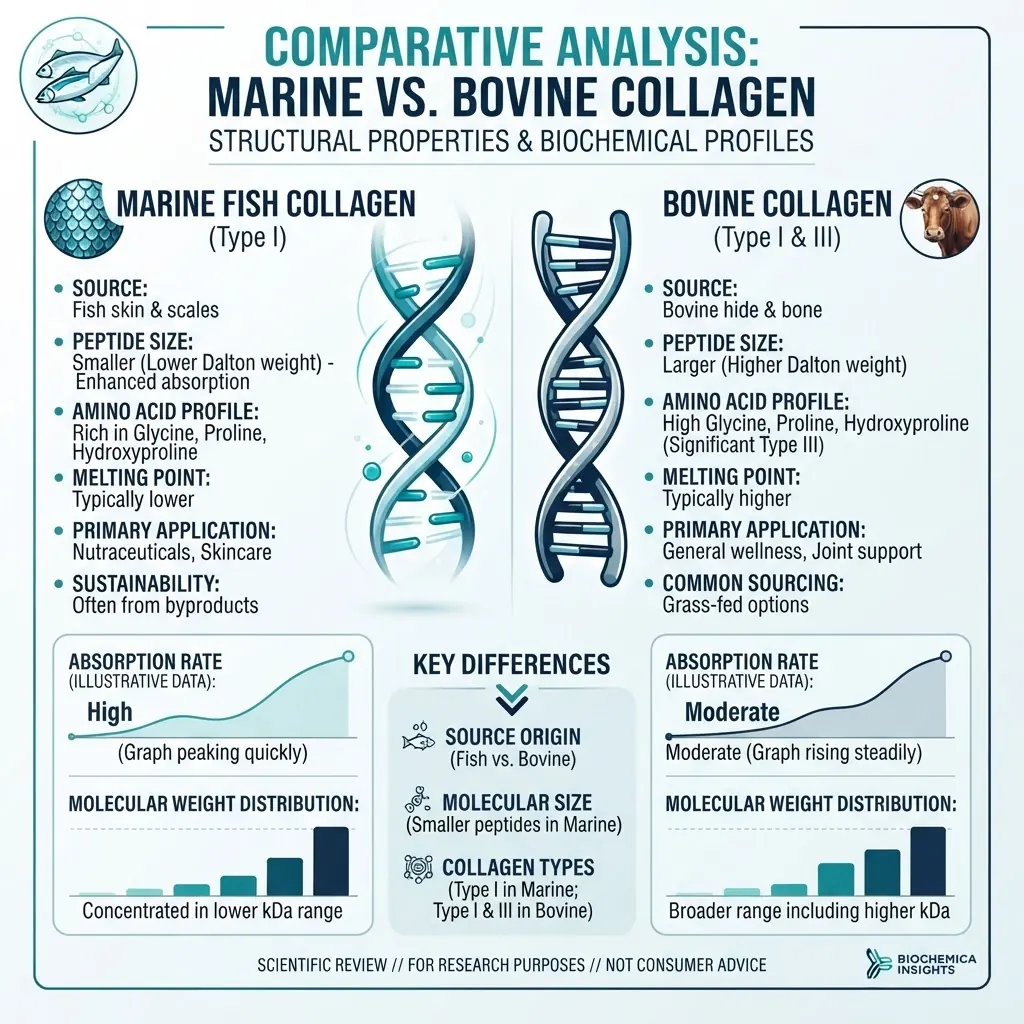
For source-level comparisons, see [Marine vs. Bovine Collagen: Source Comparison for Laboratory Studies](/blog/marine-vs-bovine-collagen-lab-comparison).
What is the amino-acid composition?
Hydrolysis does not replace the underlying amino-acid composition of collagen, but processing can modify how residues are detected. Collagen is rich in glycine, proline, hydroxyproline, alanine, glutamate, arginine, and aspartate. Hydroxyproline is particularly useful as a collagen-associated analytical marker, although it is not sufficient on its own to establish source, purity, or sequence distribution.
Acid processing can destroy tryptophan, while glutamine and asparagine may be deamidated. Alkaline conditions can promote oxidation or racemisation of susceptible residues. Amino-acid analysis, peptide mapping, and mass spectrometry should therefore be interpreted alongside the documented process history.
Amino-acid analysis can help assess source consistency, non-collagen protein contribution, and batch-to-batch variation. Unexpected ratios may indicate contamination, incomplete purification, or a different raw material. The result is most useful when compared with a reference specification and supported by chromatographic data.
How do hydrolysed collagen peptides behave in solution?
Shorter fragments generally dissolve more readily and produce lower-viscosity solutions than native collagen. Solubility depends on molecular size, sequence, pH, temperature, ionic strength, concentration, and mixing order. A clear solution does not by itself demonstrate purity or molecular uniformity.
Aggregation can still occur. Cysteine-containing sequences may form disulphide-linked species, higher concentrations may promote non-covalent association, and metal ions can alter apparent particle size. SEC, dynamic light scattering, turbidity measurements, or analytical centrifugation can be used when aggregation could affect an assay.
Stability should be assessed under the actual storage and experimental conditions. Important variables include moisture exposure, repeated temperature changes, extreme pH, oxidation, protease activity in culture media, and adsorption to low-binding or standard plasticware. See [Peptide Storage and Stability Best Practices](/blog/peptide-storage-stability-science-backed-best-practices) for a broader handling framework.
Which analytical methods characterise hydrolysed collagen?
A defensible characterisation package combines methods with different sources of selectivity:
- Amino-acid analysis estimates composition and supports source comparison.
- Reverse-phase HPLC separates species by hydrophobicity and provides a chromatographic fingerprint.
- Size-exclusion chromatography estimates molecular-weight distribution and residual high-mass material.
- LC-MS/MS identifies peptide sequences and can confirm marker fragments.
- MALDI-TOF provides rapid mass profiling across a suitable range.
- Hydroxyproline assays estimate collagen-associated content in mixtures.
- Endotoxin and microbial testing are important before cell-culture work.
Method selection should follow the research question. SEC is central when distribution is the primary variable; LC-MS/MS is more informative when sequence identity matters; HPLC is useful for fingerprints and relative purity. Include chromatograms, calibration details, sample preparation, and acceptance criteria in the batch record.
For method-development context, see the [HPLC Chromatography Guide](/blog/hplc-chromatography-guide) and [Peptide Purity Testing Standards](/blog/peptide-purity-testing-standards).
What are the in-vitro research applications?
Hydrolysed collagen is used in controlled laboratory models of matrix interaction, peptide signalling, and material behaviour. In cell-culture studies, it may be evaluated as a soluble test material, a coating component, or one part of a hydrogel or scaffold formulation. Relevant readouts can include adhesion, migration, matrix-marker expression, protease activity, and morphology.
Specific fragments such as Pro-Hyp, Hyp-Gly, and Gly-Pro-Hyp are frequently discussed in the literature because sequence-defined materials allow researchers to separate sequence effects from bulk composition. A result obtained with a purified fragment should not automatically be attributed to a broad hydrolysate containing thousands of species.
Tissue-engineering studies may use characterised fractions in hydrogels, electrospun materials, or three-dimensional culture models. In each case, the report should distinguish material properties from biological readouts and state whether the preparation was sterile, endotoxin-tested, and analytically verified.
For receptor and matrix-signalling context, see [Peptide Signaling in Dermal Cell Research](/blog/peptide-signaling-dermal-cell-research) and [Marine Collagen Peptide Fractions: Analytical Comparison](/blog/marine-collagen-peptide-fractions-analysis).
How should experiments be designed?
Define the concentration basis before starting. Total peptide mass, collagen-associated content, and molar concentration are not interchangeable. A study should state the selected cell model, passage range, vehicle, exposure window, temperature, pH, and whether the material was sterile-filtered.
Useful controls include an uncoated or untreated control, a native-collagen comparison, a vehicle control, and a positive control appropriate to the readout. Run a concentration-response series rather than relying on one test level, and include independent biological replicates. Verify the material by SEC, HPLC, or mass spectrometry when a new batch is introduced.
A practical documentation set includes the supplier batch, source species, hydrolysis enzyme or reagent, storage history, reconstitution method, final pH, concentration calculation, and any visible change in clarity or precipitation. These details make it possible to distinguish a material effect from a handling artefact.
Common interpretation errors
The most common errors are treating all hydrolysates as equivalent, reporting a nominal mass without a composition basis, relying on one analytical method, pooling batches without verification, and assuming an in-vitro observation predicts an outcome outside the model. Other risks include unreported aggregation, inadequate controls, and failure to test for endotoxin or microbial contamination before cell work.
A clear research report should identify what was measured, what was inferred, and what remains uncertain. It should not use a product label or a generic molecular-weight claim as a substitute for batch-specific data.
Frequently Asked Questions
What is hydrolysed collagen?
Hydrolysed collagen is native collagen cleaved into shorter peptide fragments by chemical or enzymatic processing. The resulting preparation differs from native collagen in molecular size, solubility, charge distribution, and sequence presentation.
What is the difference between acid and enzymatic hydrolysis?
Acid hydrolysis uses acidic conditions and often produces broad cleavage products. Enzymatic hydrolysis uses proteases with defined substrate preferences and can be more reproducible when process conditions are controlled.
What is the typical molecular weight?
Reported preparations range from a few hundred daltons to several kilodaltons, with many standard hydrolysates showing a broad distribution around 1–10 kDa. The actual profile should be measured rather than inferred from a label.
How is molecular weight verified?
Use SEC as a primary distribution method, supported by SDS-PAGE for larger fragments and MALDI-TOF or LC-MS/MS for mass and sequence information.
Does processing affect amino-acid composition?
The collagen composition is largely retained, but acid, alkaline, and enzymatic conditions can alter the recovery or chemical state of sensitive residues. Amino-acid analysis should be interpreted with process history.
How should research material be stored?
Keep lyophilised material sealed, dry, protected from light, and at a validated low temperature. Aliquot reconstituted solutions when possible and document freeze-thaw exposure.
What controls are important?
Use untreated or uncoated controls, a native-collagen comparison, a vehicle control, and a positive control suited to the assay. Confirm the material profile when changing batches.
Conclusion
Hydrolysed collagen peptides are heterogeneous mixtures whose behaviour depends on source, process, molecular-weight distribution, sequence composition, and solution conditions. Reliable in-vitro work therefore requires more than a generic hydrolysate label: it requires analytical characterisation, controlled handling, appropriate controls, and transparent reporting. All materials discussed are intended for in-vitro laboratory research only and are not for human or animal use.
References
- Shoulders MD, Raines RT. (2009). Collagen structure and stability. Annual Review of Biochemistry, 78, 929–958.
- Gómez-Guillén MC, Giménez B, López-Caballero ME, Montero MP. (2011). Functional and bioactive properties of collagen and gelatin from alternative sources. Food Hydrocolloids, 25(8), 1813–1827.
- Sato K. (2017). The presence of food-derived collagen peptides in human body and their physiological effects. Journal of Agricultural and Food Chemistry, 65(8), 1541–1547.
- Silva TH, Moreira-Silva J, Marques ALP, et al. (2014). Marine origin collagens and their potential applications. Marine Drugs, 12(12), 5881–5901.
Frequently asked questions
What is hydrolysed collagen?
Hydrolysed collagen is native collagen cleaved into shorter peptide fragments by chemical or enzymatic processing. The resulting preparation differs from native collagen in molecular size, solubility, charge distribution, and sequence presentation.
What is the difference between acid and enzymatic hydrolysis?
Acid hydrolysis uses acidic conditions and often produces broad cleavage products. Enzymatic hydrolysis uses proteases with defined substrate preferences and can be more reproducible when process conditions are controlled.
What is the typical molecular weight?
Reported preparations range from a few hundred daltons to several kilodaltons, with many standard hydrolysates showing a broad distribution around 1–10 kDa. The actual profile should be measured rather than inferred from a label.
How is molecular weight verified?
Use SEC as a primary distribution method, supported by SDS-PAGE for larger fragments and MALDI-TOF or LC-MS/MS for mass and sequence information.
Does processing affect amino-acid composition?
The collagen composition is largely retained, but processing can alter the recovery or chemical state of sensitive residues. Amino-acid analysis should be interpreted with process history.
How should research material be stored?
Keep lyophilised material sealed, dry, protected from light, and at a validated low temperature. Aliquot reconstituted solutions when possible and document freeze-thaw exposure.
What controls are important?
Use untreated or uncoated controls, a native-collagen comparison, a vehicle control, and a positive control suited to the assay. Confirm the material profile when changing batches.
Frequently Asked Questions
What is hydrolysed collagen?
Hydrolysed collagen is native collagen cleaved into shorter peptide fragments by chemical or enzymatic processing. The resulting preparation differs from native collagen in molecular size, solubility, charge distribution, and sequence presentation.
What is the difference between acid and enzymatic hydrolysis?
Acid hydrolysis uses acidic conditions and often produces broad cleavage products. Enzymatic hydrolysis uses proteases with defined substrate preferences and can be more reproducible when process conditions are controlled.
What is the typical molecular weight?
Reported preparations range from a few hundred daltons to several kilodaltons, with many standard hydrolysates showing a broad distribution around 1–10 kDa. The actual profile should be measured rather than inferred from a label.
How is molecular weight verified?
Use SEC as a primary distribution method, supported by SDS-PAGE for larger fragments and MALDI-TOF or LC-MS/MS for mass and sequence information.
Does processing affect amino-acid composition?
The collagen composition is largely retained, but processing can alter the recovery or chemical state of sensitive residues. Amino-acid analysis should be interpreted with process history.
How should research material be stored?
Keep lyophilised material sealed, dry, protected from light, and at a validated low temperature. Aliquot reconstituted solutions when possible and document freeze-thaw exposure.
What controls are important?
Use untreated or uncoated controls, a native-collagen comparison, a vehicle control, and a positive control suited to the assay. Confirm the material profile when changing batches.
Dr. Sarah Chen
Our research team combines expertise in biochemistry, skincare science, and sports medicine to bring you evidence-based peptide information.
Ready to Explore Peptides?
Discover our selection of research-grade peptides and start your optimisation journey today.
Shop Peptides