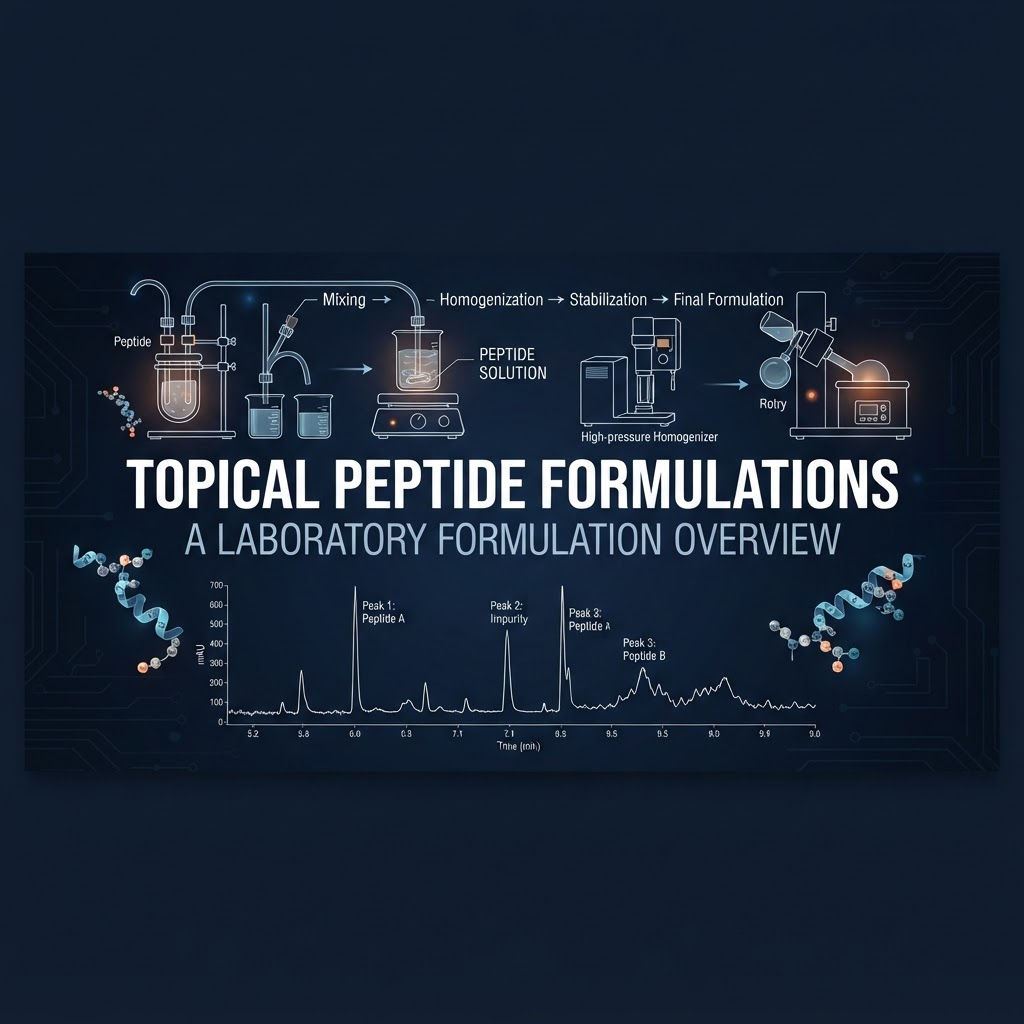
# Topical Peptide Formulations: A Laboratory Formulation Overview
Topical peptide formulations are complex systems designed to deliver peptide compounds to skin tissue in laboratory research models. Unlike simple aqueous solutions, effective topical formulations require careful selection of vehicles, excipients, penetration enhancers, and preservatives. Each variable can affect peptide stability, release kinetics, and analytical measurability.
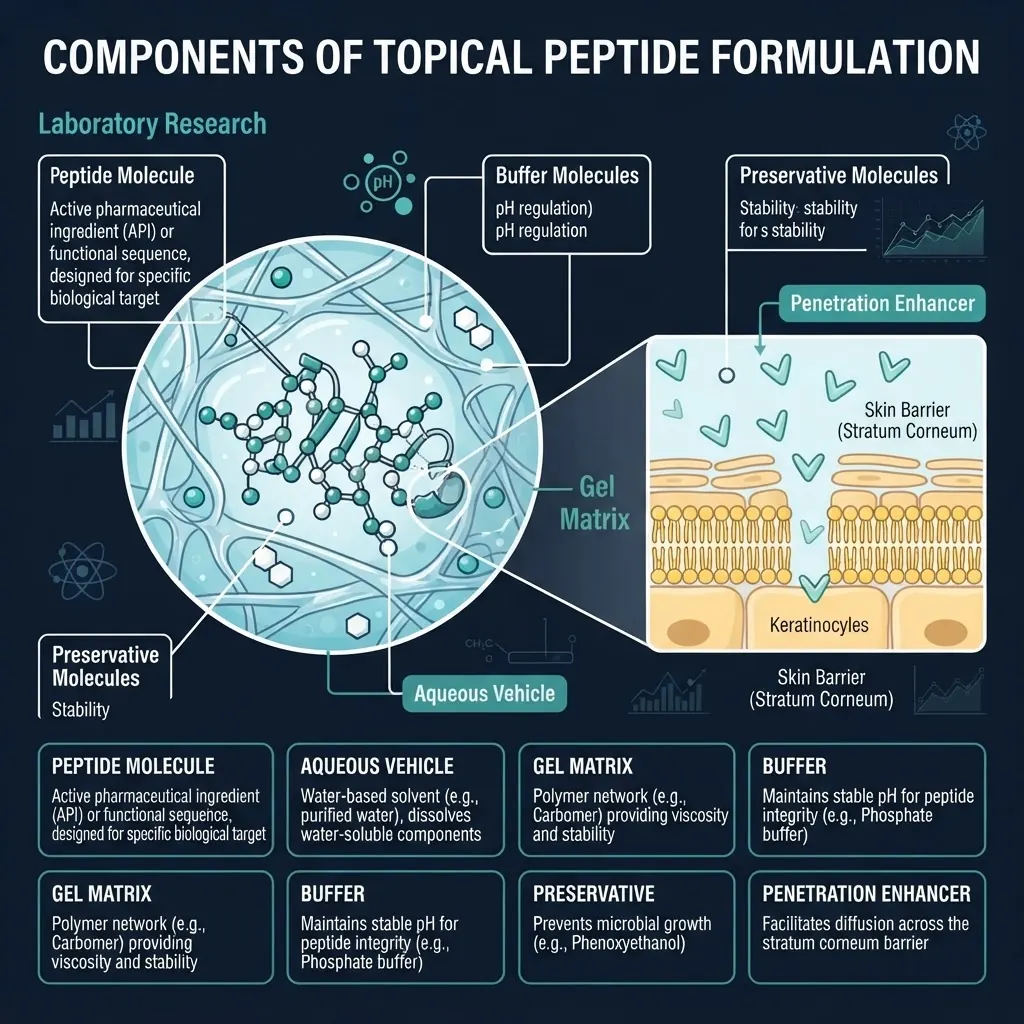
This overview covers the formulation science behind topical peptide preparations for in-vitro research, including excipient selection, penetration enhancer mechanisms, stability testing, and analytical verification. All formulations described are intended for laboratory research use only.
What are the main components of a topical peptide formulation?
A topical peptide formulation typically contains five functional component classes:
| Component | Function | Examples |
|---|---|---|
| Active peptide | Research compound | GHK-Cu, BPC-157, signaling peptides |
| Vehicle | Carries peptide and provides consistency | Water, ethanol, propylene glycol, gels |
| Penetration enhancer | Improves permeation in models | Oleic acid, terpenes, surfactants |
| Preservative | Prevents microbial growth | Benzyl alcohol, parabens, phenoxyethanol |
| Buffer or pH adjuster | Maintains stability | Citrate, phosphate, Tris |
Each component affects the others. A vehicle that improves solubility may reduce stability, while an enhancer that improves permeation may alter peptide structure. Formulation research therefore requires systematic optimisation rather than isolated ingredient selection.
What vehicle systems are used in peptide formulation research?
Vehicle selection determines solubility, release kinetics, and stability. Common systems include:
Aqueous systems
Purified water or buffered systems are suitable for hydrophilic peptides. They are straightforward to assay, but may require preservation for repeated laboratory sampling and generally provide limited permeation without additional excipients.
Hydroalcoholic systems
Water-ethanol mixtures can improve solubility for some compounds and provide mild barrier modification. Ethanol concentration affects peptide stability, so each compound and concentration must be evaluated independently.
Glycol-based systems
Propylene glycol or polyethylene glycol vehicles can improve solubility and provide humectant properties. They may also affect chromatographic separation or interact with peptide chains, requiring analytical compatibility testing.
Emulsion systems
Oil-in-water and water-in-oil emulsions allow hydrophilic and lipophilic components to coexist. Their complexity means emulsifier choice, droplet size, phase stability, and peptide distribution all need to be measured.
Gel systems
Carbomer, hydroxyethylcellulose, and related gelling agents can improve residence time and support controlled release in in-vitro models. The gelling agent must remain compatible with the peptide and the intended assay.
For related formulation work, see our [Bacteriostatic Mixing Water product page](/product/10ml-bacteriostatic-mixing-water) and [Acetic Acid 0.6% Peptide Solvent](/product/10ml-acetic-acid-0-6-percent-peptide-solvent).
What are penetration enhancers and how do they work?
Penetration enhancers are compounds that increase the permeability of biological barriers in in-vitro models. They may act through lipid fluidisation, lipid extraction, solvent drag, protein interaction, or tight-junction modulation.
| Enhancer class | Mechanism | Examples |
|---|---|---|
| Fatty acids | Disrupt lipid organisation | Oleic acid, lauric acid |
| Terpenes | Modify intercellular lipids | Menthol, limonene |
| Surfactants | Solubilise lipid domains | Tween 80, Span 20 |
| Alcohols | Extract or reorganise lipids | Ethanol, isopropanol |
| Azones | Interact with lipid domains | Laurocapram |
| Peptide-based | Modulate cellular transport | Cell-penetrating peptides |
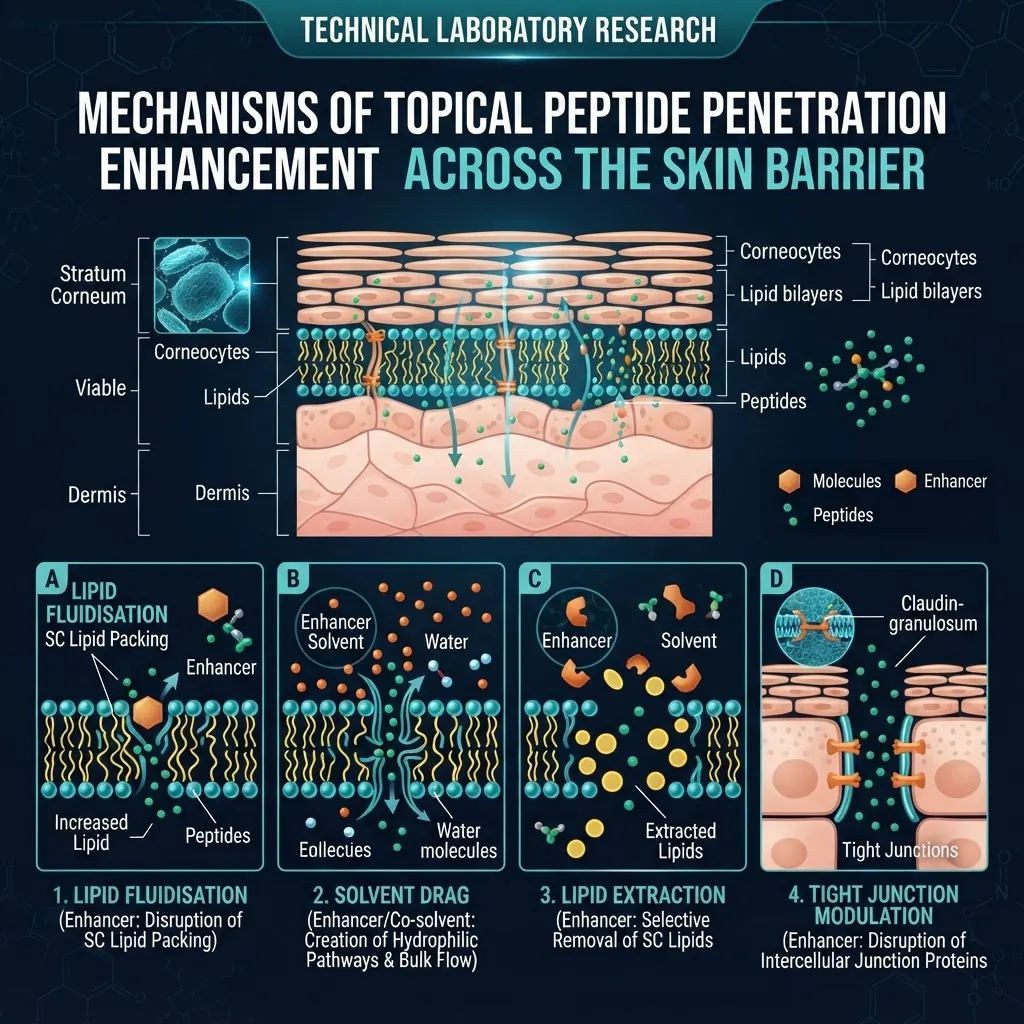
When selecting an enhancer, researchers should assess peptide compatibility, interference with the analytical method, reversibility in the model, concentration-response behaviour, and any relevant research-use restrictions. An enhancer that increases transport but causes degradation or assay interference is not a useful formulation variable.
For broader context, see [Peptide Signaling in Dermal Cell Research: A Technical Overview](/blog/peptide-signaling-dermal-cell-research).
How do you assess peptide stability in topical formulations?
Vehicle composition, pH, temperature, light, oxygen, and excipient interactions can all influence stability. A structured pre-formulation screen should be completed before a final vehicle is selected.
Pre-formulation stability testing
- Prepare the peptide at the target concentration in each candidate vehicle.
- Incubate samples at 25°C and 37°C.
- Sample at 0, 24, 48, 72, and 168 hours.
- Analyse intact peptide by HPLC.
- Calculate degradation rate and apparent half-life.
For a related guide, see [Peptide Storage and Stability Best Practices](/blog/peptide-storage-stability-science-backed-best-practices).
Accelerated stability testing
| Condition | Purpose | Duration |
|---|---|---|
| 40°C / 75% RH | Accelerated thermal stress | 1–3 months |
| 25°C / 60% RH | Real-time stability | 6–24 months |
| Freeze-thaw cycles | Physical stability | 3–5 cycles |
| Light exposure | Photostability | 1–30 days |
| Mechanical stress | Shear stability | Variable |
HPLC can quantify intact peptide and reveal new peaks, while mass spectrometry helps identify degradation products. pH, viscosity, particle size, and visual inspection add complementary physical measurements.
What analytical methods verify formulation quality?
Formulation verification requires complementary chemical, physical, and microbiological measurements.
Peptide content assay
Measure actual concentration using UV absorbance at 214 or 280 nm, a validated colorimetric assay, or amino acid analysis. The selected method should be validated for the vehicle matrix rather than assumed to transfer from a simple buffer.
Homogeneity testing
Sample from the top, middle, and bottom of the container, then analyse each sample by HPLC. A predefined acceptance range should be established before testing; a common development target is less than 5% variation between locations.
Release kinetics
Place the formulation in a diffusion cell using an artificial membrane or skin model. Sample receptor fluid at timed intervals, quantify peptide by HPLC, and calculate flux and cumulative release. Membrane selection, temperature, receptor composition, and sink conditions should be recorded.
Preservative efficacy
Where preservation is part of the research design, a challenge study can assess microbial control over time. The method, organisms, sampling schedule, and acceptance criteria should be documented, with ISO 11930 used only as an appropriately adapted reference for the research context.
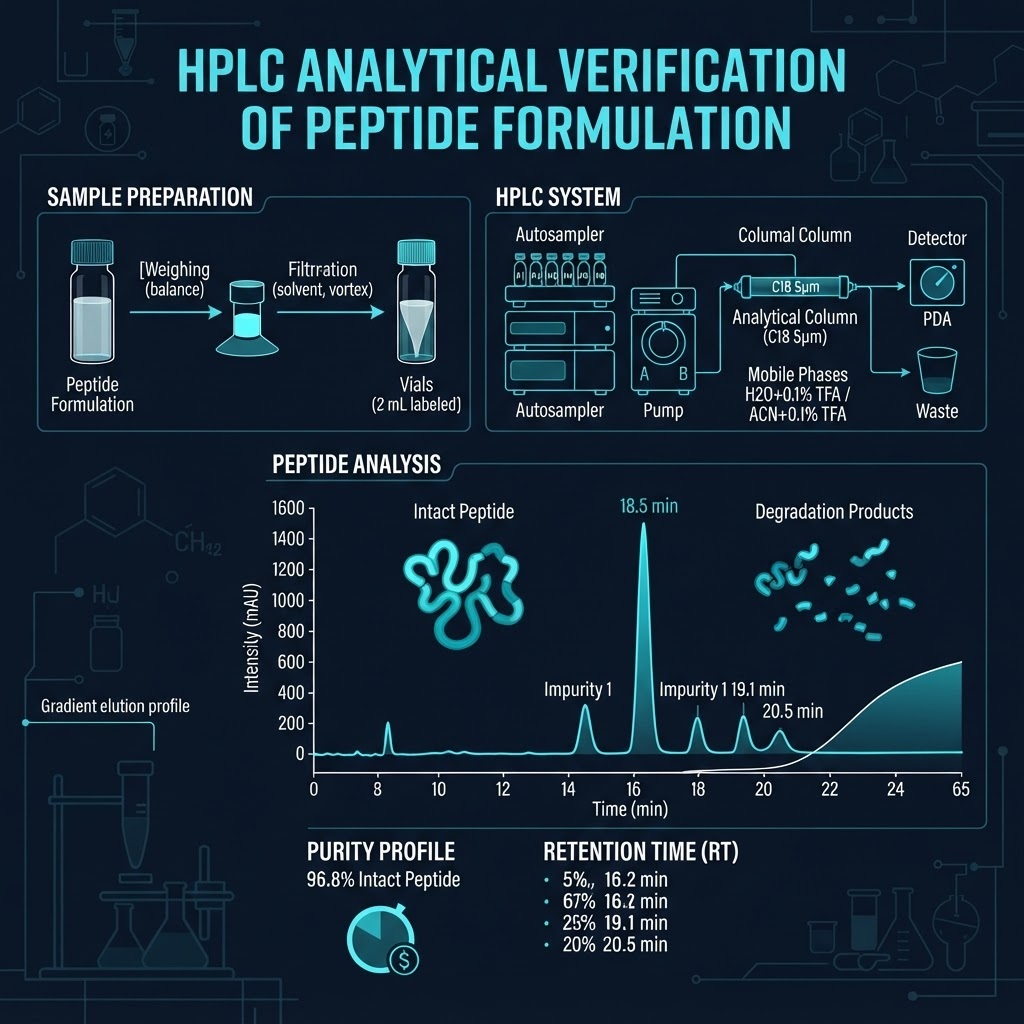
For additional analytical context, see [HPLC Chromatography Guide](/blog/hplc-chromatography-guide) and [Peptide Purity Testing Standards](/blog/peptide-purity-testing-standards).
What are the key formulation challenges?
Peptide-excipient interactions may involve adsorption to container surfaces, complexation with metal ions or surfactants, oxidation of susceptible residues, pH-dependent hydrolysis, and aggregation. Each interaction can change measured concentration without changing the nominal preparation record.
pH optimisation must balance peptide stability with vehicle compatibility. Acidic peptides may perform best in a mildly acidic range, basic peptides in a less acidic range, and copper-containing systems within a compound-specific window. These ranges are starting points for screening, not universal specifications.
Preservation creates a similar trade-off. Benzyl alcohol, phenoxyethanol, parabens, sorbate salts, and benzalkonium chloride can have different compatibility profiles depending on peptide charge, concentration, pH, and container material. Every peptide-preservative pair needs direct testing.
How do you design a formulation study?
A systematic study can be organised into five phases:
Phase 1 — Pre-formulation
Characterise physicochemical properties, screen vehicles for solubility, measure short-term stability, and select two or three candidates.
Phase 2 — Formulation development
Add enhancers to selected vehicles, assess compatibility, optimise pH and buffer capacity, and evaluate preservation.
Phase 3 — Stability testing
Run accelerated, real-time, freeze-thaw, photostability, and mechanical stress studies according to a documented sampling plan.
Phase 4 — Analytical verification
Measure content, homogeneity, release kinetics, degradation products, physical properties, and preservative performance.
Phase 5 — In-vitro evaluation
Use diffusion cells, cell culture compatibility studies, and validated analytical methods to evaluate transport and formulation behaviour.
For related context, see our [Cell Signaling research category](/research/cell-signaling).
Related Research and Products
Related research articles include [Peptide Signaling in Dermal Cell Research](/blog/peptide-signaling-dermal-cell-research), [Retinoid vs. Peptide Mechanisms](/blog/retinoid-vs-peptide-mechanisms-in-vitro), [HPLC Chromatography Guide](/blog/hplc-chromatography-guide), [Peptide Purity Testing Standards](/blog/peptide-purity-testing-standards), [Peptide Storage and Stability](/blog/peptide-storage-stability-science-backed-best-practices), and [What is GHK-Cu Copper Peptide?](/blog/what-is-ghk-cu-copper-peptide).
Related research products include [GHK-Cu 50mg Copper Peptide](/product/ghk-cu-50mg-copper-peptide), [Bacteriostatic Mixing Water](/product/10ml-bacteriostatic-mixing-water), [Acetic Acid 0.6% Peptide Solvent](/product/10ml-acetic-acid-0-6-percent-peptide-solvent), [BPC-157 5mg](/product/bpc-157-5mg), [TB-500](/product/thymosin-beta-4-5mg-tb500), and [Peptide Storage Case](/product/peptide-storage-case).
Research categories include [Cell Signaling](/research/cell-signaling), [Repair Signaling Peptides](/research/repair-signaling-peptides-overview), and [Lab Accessories](/research/lab-accessories).
Frequently Asked Questions
What is the optimal pH for topical peptide formulations?
Optimal pH varies by peptide class and vehicle. It must be tested empirically for each formulation rather than inferred from a general range.
Which preservative is most compatible with research peptides?
Compatibility depends on peptide charge, pH, concentration, and vehicle. Benzyl alcohol and phenoxyethanol are common screening candidates, but direct testing is required.
How do penetration enhancers affect peptide stability?
Surfactants and fatty acids may alter peptide structure, while other enhancers may be more compatible. Each enhancer requires a stability and assay-interference screen.
How long does a topical peptide formulation remain stable?
Stability varies by compound, vehicle, container, and storage conditions. Accelerated studies support prediction, while real-time studies confirm performance.
What analytical methods verify formulation stability?
HPLC, mass spectrometry, pH, viscosity, particle size, and visual inspection provide complementary evidence.
How do I test peptide release from a topical formulation?
Diffusion-cell studies use a membrane or skin model, timed receptor-fluid sampling, and validated peptide quantification.
What peptide-excipient interactions should I test?
Test adsorption, complexation, oxidation, hydrolysis, aggregation, and any impact on analytical recovery.
What is the difference between accelerated and real-time stability testing?
Accelerated testing uses elevated stress to support prediction; real-time testing observes the formulation under intended storage conditions.
Conclusion
Topical peptide formulation research requires systematic attention to vehicle selection, enhancer choice, pH, preservation, and analytical verification. Pre-formulation studies, stability testing, and method validation are essential for reproducible in-vitro results.
All formulations described here are intended for laboratory research only. They are not medicines, supplements, or consumer products, and are not for human or animal use.
References
- Benson HAE, Watkinson AC. (2012). Transdermal and Topical Drug Delivery: Principles and Practice. Wiley.
- Lane ME. (2013). Skin penetration enhancers. International Journal of Pharmaceutics, 447(1–2), 12–21.
- Williams AC, Barry BW. (2004). Penetration enhancers. Advanced Drug Delivery Reviews, 56(5), 603–618.
- Schagen SK. (2017). Topical peptide treatments with effective anti-aging results. Cosmetics, 4(2), 16.
- Lintner K, Peschard O. (2000). Biologically active peptides. International Journal of Cosmetic Science, 22(3), 207–218.
Frequently asked questions
What is the optimal pH for topical peptide formulations?
Optimal pH varies by peptide class and vehicle. It must be tested empirically for each formulation rather than inferred from a general range.
Which preservative is most compatible with research peptides?
Compatibility depends on peptide charge, pH, concentration, and vehicle. Benzyl alcohol and phenoxyethanol are common screening candidates, but direct testing is required.
How do penetration enhancers affect peptide stability?
Surfactants and fatty acids may alter peptide structure, while other enhancers may be more compatible. Each enhancer requires a stability and assay-interference screen.
How long does a topical peptide formulation remain stable?
Stability varies by compound, vehicle, container, and storage conditions. Accelerated studies support prediction, while real-time studies confirm performance.
What analytical methods verify formulation stability?
HPLC, mass spectrometry, pH, viscosity, particle size, and visual inspection provide complementary evidence.
How do I test peptide release from a topical formulation?
Diffusion-cell studies use a membrane or skin model, timed receptor-fluid sampling, and validated peptide quantification.
What peptide-excipient interactions should I test?
Test adsorption, complexation, oxidation, hydrolysis, aggregation, and any impact on analytical recovery.
What is the difference between accelerated and real-time stability testing?
Accelerated testing uses elevated stress to support prediction; real-time testing observes the formulation under intended storage conditions.
Frequently Asked Questions
What is the optimal pH for topical peptide formulations?
Optimal pH varies by peptide class and vehicle. It must be tested empirically for each formulation rather than inferred from a general range.
Which preservative is most compatible with research peptides?
Compatibility depends on peptide charge, pH, concentration, and vehicle. Benzyl alcohol and phenoxyethanol are common screening candidates, but direct testing is required.
How do penetration enhancers affect peptide stability?
Surfactants and fatty acids may alter peptide structure, while other enhancers may be more compatible. Each enhancer requires a stability and assay-interference screen.
How long does a topical peptide formulation remain stable?
Stability varies by compound, vehicle, container, and storage conditions. Accelerated studies support prediction, while real-time studies confirm performance.
What analytical methods verify formulation stability?
HPLC, mass spectrometry, pH, viscosity, particle size, and visual inspection provide complementary evidence.
How do I test peptide release from a topical formulation?
Diffusion-cell studies use a membrane or skin model, timed receptor-fluid sampling, and validated peptide quantification.
What peptide-excipient interactions should I test?
Test adsorption, complexation, oxidation, hydrolysis, aggregation, and any impact on analytical recovery.
What is the difference between accelerated and real-time stability testing?
Accelerated testing uses elevated stress to support prediction; real-time testing observes the formulation under intended storage conditions.
Emma Lawrence
Our research team combines expertise in biochemistry, skincare science, and sports medicine to bring you evidence-based peptide information.
Ready to Explore Peptides?
Discover our selection of research-grade peptides and start your optimisation journey today.
Shop Peptides